Budget Submission to Ford’s Upcoming 2026/27 Provincial Budget

Each budget cycle, the provincial government seeks input from education partners across the province as it determines its education funding for the coming budget. As always, Fix Our Schools took the opportunity to provide input and our recommendations in our submission to the Ontario government’s budget consultation process.

This year, the Ford government’s main ask was for submissions focused on how the government ought to plan for a budget that

  • protects Ontario’s economy and workers
  • creates more jobs
  • keeps taxes low and costs down
  • delivers better services
  • gets critical infrastructure projects built

We believe that investing in the publicly funded education of Ontario’s youth is critical to a strong economy and that in order to do this, our government must ensure that every publicly funded school in the province is considered critical infrastructure and is safe, well-maintained, healthy, and provides an environment conducive to learning and working.

We continued to call on this government to lift the school closure moratorium that has been in place since 2017 and adopt a new approach to school closures. We also continued to call on this government to develop and implement a Standard of Good Repair for Ontario’s publicly funded schools, which would include transparent metrics for school buildings, portables, and schoolyards, addressing:

    • The $16.8-billion+ of disrepair in school buildings
    • A program to assess current repair backlogs in portables and schoolyards
    • Air quality and ventilation
    • Classroom temperatures
    • Accessibility
    • Environmental efficiency & durability
    • Job site safety for school construction projects and maintenance work
    • Drinking water
    • Asbestos
    • Cleanliness
    • Classroom space
    • Vermin, mold
    • Fire and electrical code

Finally, we called on the government to prioritize publicly funded schools by ensuring they receive adequate, stable, equitable provincial funding that would allow school boards to meet these provincial standards and publicly demonstrate positive outcomes by collecting and releasing associated metrics at regular intervals.

Our pre-budget consultation submission for 2025-26

Each budget cycle, the provincial government seeks input from education partners across the province as it determines its education funding for the coming budget. As always, Fix Our Schools took the opportunity to provide input and our recommendations in our submission to the Education Funding Consultation.

We continued to call on the Ford government to ensure that every publicly funded school in the province is safe, well-maintained, healthy, and provides an environment conducive to learning and working.

We continued to call on this government to lift the school closure moratorium that has been in place since 2017 and adopt a new approach to school closures. We also continued to call on this government to develop and implement a Standard of Good Repair for Ontario’s publicly funded schools, which would include transparent metrics for school buildings, portables, and schoolyards, addressing:

    • The $16.8-billion+ of disrepair in school buildings
    • A program to assess current repair backlogs in portables and schoolyards
    • Air quality and ventilation
    • Classroom temperatures
    • Accessibility
    • Environmental efficiency & durability
    • Job site safety for school construction projects and maintenance work
    • Drinking water
    • Asbestos
    • Cleanliness
    • Classroom space
    • Vermin, mold
    • Fire and electrical code

Finally, we called on the government to prioritize publicly funded schools by ensuring they receive adequate, stable, equitable provincial funding that would allow school boards to meet these provincial standards and publicly demonstrate positive outcomes by collecting and releasing associated metrics at regular intervals.

Our Contribution to the Budget Consultation for 2024/25 Provincial Budget

As part of the provincial budget planning process, the government seeks input from education partners across the province. As always, Fix Our Schools took the opportunity to provide input and our recommendations as outlined in this document.

We continued to call on the Ford government to ensure that every publicly funded school in the province is safe, well-maintained, healthy, and provides an environment conducive to learning and working.

We also continued to call on this government to develop and implement a Standard of Good Repair for Ontario’s publicly funded schools, which would include transparent metrics for school buildings, portables, and schoolyards, addressing:

    • The $16.8-billion+ of disrepair in school buildings
    • A program to assess current repair backlogs in portables and schoolyards
    • Air quality and ventilation
    • Classroom temperatures
    • Accessibility
    • Environmental efficiency & durability
    • Job site safety for school construction projects and maintenance work
    • Drinking water
    • Asbestos
    • Cleanliness
    • Classroom space
    • Vermin, mold
    • Fire and electrical code

Finally, we called on the government to prioritize publicly funded schools by ensuring they receive adequate, stable, equitable provincial funding that would allow school boards to meet these provincial standards and publicly demonstrate positive outcomes by collecting and releasing associated metrics at regular intervals.

A 28-minute retrospective on the Fix Our Schools campaign

Scott Neigh believes that, “every community, every workplace, and every individual life in Canada owes some of their current shape to long histories of struggle by ordinary people. And the lives we live tomorrow, next year, and in seven generations will be shaped by the struggles going on today.”

He is also the founder of “Talking Radical”, a multifaceted project grounded in grassroots voices from across Canada and aimed at people who think movements matter. Fix Our Schools was interviewed by Scott Neigh as part of the “Talking Radical Radio“, and we so appreciated his format of doing an in-depth interview with us. This 28-minute interview with Scott Neigh provides an excellent retrospective and overview of the Fix Our Schools campaign – and we encourage you to give it a listen!


Toronto Community Housing Complex Operating at Only 75% Capacity. Why?

All 114 families who used to live at the Swansea Mews complex in the west end of Toronto have been forced from their homes because they have been deemed structurally unsafe. A ceiling panel in one home fell in late May, seriously injuring a local Mom. Now, for the foreseeable future, these 114 families face incredible uncertainty, frustration, overwhelm, and unexpected expenses, as they find themselves without secure housing, not knowing when (if ever) they might be able to return to Swansea Mews.

Throughout our campaign’s 8-year history, Fix Our Schools has periodically followed the issue of disrepair in Toronto Community Housing (TCH) buildings. The dynamic of chronic and gross underfunding is similar to the dynamic faced by school boards. A long history of downloading responsibility for important social goods like schools, education and social housing while higher levels of government fail to provide the adequate, stable funding required has not lead to positive outcomes, as is evidenced in the recent case of Swansea Mews.

Frustratingly, we have read in several news reports that the Swansea Mews complex was operating at only around 75% capacity when the ceiling tile file in late May. In a city where affordable housing is so desperately needed, this seems unacceptable and short-sighted. Fix Our Schools has been trying to ascertain why 25% of this affordable housing stock remained empty, and to find out the occupancy rate of TCH properties overall. Our suspicion is that the 25% of units not in use at Swansea Mews had been in such a state of disrepair that they were deemed uninhabitable, and our suspicion is also that this situation is not unique to this one TCH property. As of July 18, 2022, we have not received confirmation of these suspicions but will update this blog accordingly once we have the information we are seeking.

If our suspicions are confirmed, then this is an issue that rests on the shoulders of all 3 levels of government, and is a fairly straight forward issue of simply providing sufficient money for TCH to be able to reasonably take care of its buildings. If we, as a society agree that affordable housing is an important social good, then there is no excuse for failing to provide the stable, adequate funding required to ensure that these homes are safe, healthy and well-maintained.

Both Housing and Schools Must be Safe, Healthy & Well-Maintained

Residents of the Swansea Mews complex at Windermere & the Queensway have been forced from their homes because they have been deemed structurally unsafe. A ceiling panel in one home fell in late May, seriously injuring a local Mom. All 114 families living at the Swansea Mews are now facing incredible uncertainty, frustration, overwhelm, and unexpected expenses, as they find themselves without secure housing for the foreseeable future. A June 8, 2022 Toronto Star article by Ben Spurr entitled, “Toronto community housing buildings score worst in city’s own evaluations“, highlights the “sometimes dire condition of Toronto’s social housing stock”.

Sadly, the horrible situation at Swansea Mews is one that could have been predicted and prevented. Almost a decade ago, in his March 2015 Toronto Star column entitled, “Toronto public housing needs a Plan B”, Edward Keenan stated,

Bad news: If something significant doesn’t change, Toronto’s social housing agency will be forced to shutter 7,500 units by 2023 because they’ll be uninhabitable, and fully 90 per cent of the existing units will be in poor or critical condition. Making the repairs to prevent this will cost $1.7 billion more over the next decade than the city has already committed.

Good news: Toronto Community Housing and Mayor John Tory have a plan, unveiled in a press conference Monday and contained in a report released at the same time.

More bad news: The plan is to ask the provincial and federal governments to cover the shortfall.”

Back in this 2015 column, Keenan agreed with John Tory’s argument that the moral and business cases made a bullet-proof case for why the provincial and federal governments should invest to repair housing. However, Keenan also pointed out that while the moral and business cases for supporting social housing have been clear for a long time, higher levels of government have continued to download responsibility and accountability for this important public good.

While Fix Our Schools has always focused on ensuring safe, healthy, well-maintained public schools, we have drawn parallels over the years between the large and growing disrepair in Ontario’s schools and within Toronto Community Housing buildings.

With the recent situation at Swansea Mews, we are once again revisiting this parallel, and identifying the root cause as gross and chronic underfunding of a public good that we, as a society, agreed we wanted many decades ago. Much like public schools, social housing also requires stable, adequate funding in order to be safe, healthy and well-maintained. Sadly, much like public schools, social housing has not received the levels of funding needed. This must change.

Schools in Mississauga Plagued by $755-M of Disrepair

Mississauga schools still waiting for provincial funding for $755,000,000 in outstanding repairs — impacting HVAC systems, roofs, foundations & drinking water— despite many Ontario MPP’s signing a pledge to address this issue in the last election.

The province’s own data is compelling — Port Credit Secondary School needs $19-M in repairs, Glenforest Secondary clocks in at $15.1-M, and Huntington Ridge Public School $3.7-M.

Krista Wylie, co-founder of Fix Our Schools, a non-partisan school advocacy group, warns of the impacts on the health of Ontario students during a critical period when well maintained schools are essential. Wylie’s example is compelling: “Ontario schools with large repair backlogs, like Port Credit Secondary, have so many outstanding repairs that the cost of those repairs would go a long way to fund a brand new school with modern ventilation. Children spend 6+ hours a day in these schools.”

Fix Our Schools, an Ontario-wide campaign, approached every candidate running in the 2018 provincial election with a pledge request. They asked candidates to “make a commitment to ensure that our schools are safe, healthy, well-maintained buildings that provide environments conducive to learning and working.” This included creating a State of Good Repair Standard by 2022 that would put standards, measurements & metrics in place for school buildings and fund them.

Hundreds of candidates signed the pledge and a full 58 of those signatories became Members of Provincial Parliament. Twenty-three Progressive Conservative MPP’s were signatories. In Mississauga, MPP Deepak Anand, MPP Rudy Cuzzetto, and MPP Natalia Kusendova had committed to improve school conditions by bringing them up to an accepted standard.

Despite the power of a PC majority government, no action has been taken on the development of this standard to date.

Fix Our Schools has routinely called on the province to fund schools wisely. “Taxpayer dollars are wasted because the government has refused to fund proactive repairs. Every building manager knows that reactive repairs cost more than regular maintenance.”

Why is a Standard of Good Repair so vital?

  • Increased academic performance and decreased absenteeism
  • Increased ventilation because Covid is airborne
  • Removing health issues related to aging buildings will improve the health of students
  • Schools are valuable assets owned by taxpayers that need to be maintained to keep their value
  • The lack of crucial technology and stable wi-fi is related to the disrepair backlog
  • School building conditions impact Ontario’s economy

What does a typical school repair list look like?

Lists of urgent repairs typically include all the basics: ventilation (HVAC), heat (hot water boilers), power (electricity transformers), drinking water, structural issues, leaking roofs, and emergency exits. The vast majority of repairs are large, vital systems, but small items can still be dangerous

Important to note is that the $755-M of disrepair logged in Scarborough schools does NOT include repairing portables, filtering or monitoring classroom air, removing lead in drinking water (63% of schools), remediating asbestos (70% of schools), solving poor classroom temperatures (no A/C in schools and poorly heated classrooms), or accessibility retrofits (AODA deadline is 2025). The province does not track these repair, remediation or renovation needs.

Disrepair in Etobicoke Schools Hits $611.8-M

Government data show $611.8 Million of Disrepair Etobicoke Schools

Etobicoke schools are still waiting for provincial funding for over half a billion in outstanding repairs — impacting HVAC systems, roofs, foundations & drinking water— despite many Ontario MPP’s signing a pledge to address this issue in the last election.

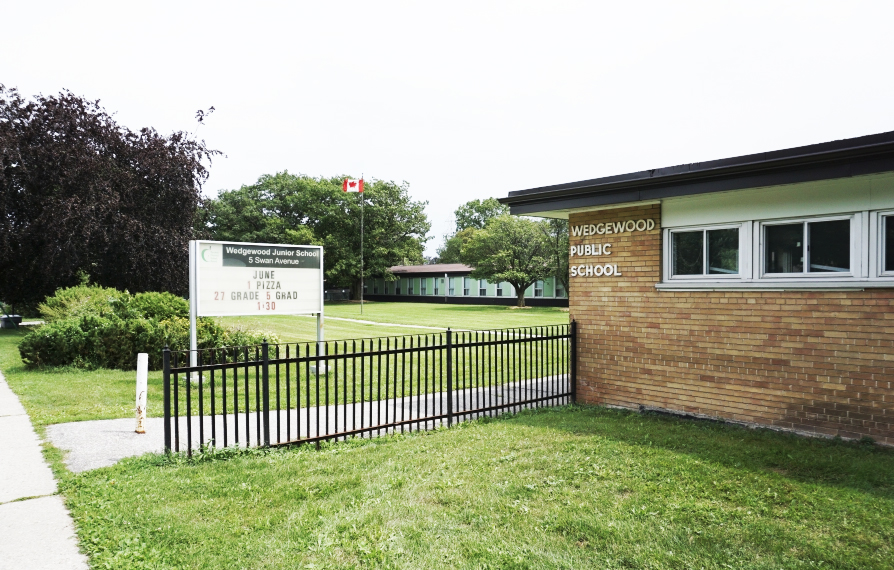
The province’s own data is compelling — Wedgewood Junior Public School needs $4.7-M in repairs, Park Lawn Junior Middle School clocks in at $6.6-M, and Braeburn Junior School $4-M.

Krista Wylie, co-founder of Fix Our Schools, a non-partisan school advocacy group, warns of the impact on the health of Ontario students during a critical period when well-maintained schools are essential. Wylie’s example is compelling: “Braeburn Junior School has so many outstanding repairs that their cost would fund 61% of a brand new school. They include 15 urgent repairs such as HVAC ventilation, heat, wiring & washrooms. Children spend 6+ hours a day in these schools.”

Fix Our Schools, an Ontario-wide campaign, approached every candidate running in the 2018 provincial election with a pledge request. They asked candidates to “make a commitment to ensure that our schools are safe, healthy, well-maintained buildings that provide environments conducive to learning and working.” This included creating a State of Good Repair Standard by 2022 that would put standards, measurements & metrics in place for school buildings and fund them.

Hundreds of candidates signed the pledge and a full 58 of those signatories became Members of Provincial Parliament. Twenty-three Progressive Conservative MPP’s were signatories. In Etobicoke, both MPP Christine Hogarth and MPP Kinga Surma had committed to improve school conditions by bringing them up to an accepted standard by 2022.

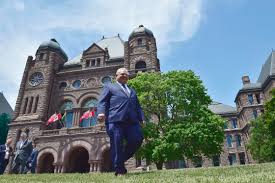
Despite the power of a PC majority government, no action has been taken on the development of this standard to date. Schools in Premier Ford’s riding need a whopping $178.4-Million in repairs.

Fix Our Schools has routinely called on the province to fund schools wisely. “Taxpayer dollars are wasted because the government has refused to fund proactive repairs. Every building manager knows that reactive repairs cost more than regular maintenance.”

Why is a Standard of Good Repair so vital?

  • Increased academic performance and decreased absenteeism
  • Increased ventilation because Covid is airborne
  • Removing health issues related to aging buildings will improve the health of students
  • Schools are valuable assets owned by taxpayers that need to be maintained to keep their value
  • The lack of crucial technology and stable wi-fi is related to the disrepair backlog
  • School building conditions impact Ontario’s economy

What does a typical school repair list look like?

Lists of urgent repairs typically include all the basics: ventilation (HVAC), heat (hot water boilers), power (electricity transformers), drinking water, structural issues, leaking roofs, and emergency exits. The vast majority of repairs are large, vital systems, but small items can still be dangerous

Wedgewood Junior Public School needs 30 high or urgent repairs. However, there is a lot missing from this list. These long repair lists do NOT include repairing portables, filtering or monitoring classroom air, removing lead in drinking water (63% of schools), remediating asbestos (70% of schools), solving poor classroom temperatures (no A/C in schools and poorly heated classrooms), or accessibility retrofits (AODA deadline is 2025). The province does not track these repair, remediation or renovation needs.

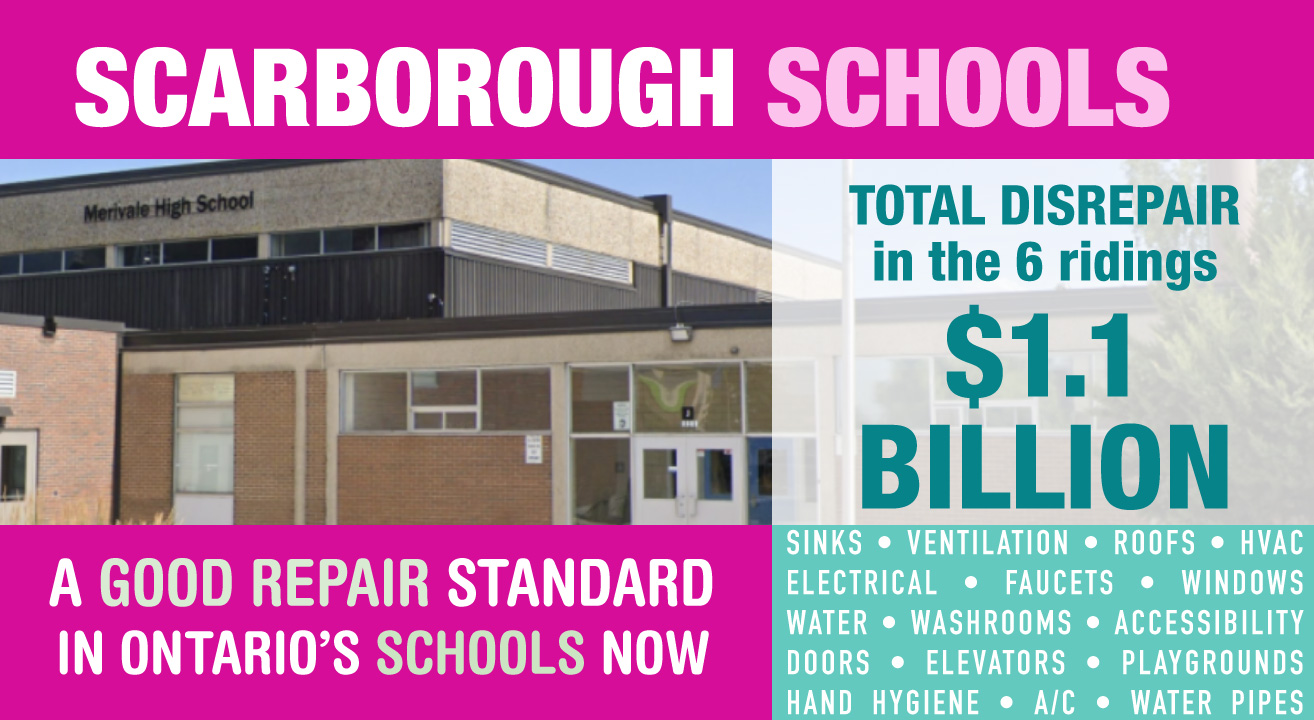
Shocking Levels of Disrepair in Scarborough Schools: Total of $1.1-B

Government data show $1.1-Billion of school disrepair in all 6 Scarborough ridings

Scarborough schools still waiting for provincial funding for $1.1 billion in outstanding repairs — impacting HVAC systems, roofs, foundations & drinking water— despite many Ontario MPP’s signing a pledge to address this issue in the last election.


The province’s own data is compelling — West Rouge Public School needs $4.4-M in repairs, Wexford Collegiate clocks in at $16.6-M, and North Agincourt Junior Public School $3.1-M.

Krista Wylie, a co-founder of Fix Our Schools, a non-partisan school advocacy group, warns of the impacts on the health of Ontario students during a critical period when well-maintained schools are essential. Wylie’s example is compelling: “West Rouge Junior Public School has so many outstanding repairs that their cost would fund 55% of a brand new school. They include 11 urgent repairs such as HVAC ventilation, heat, wiring & water. Children spend 6+ hours a day in these schools.”

Fix Our Schools, an Ontario-wide campaign, approached every candidate running in the 2018 provincial election with a pledge request. They asked candidates to “make a commitment to ensure that our schools are safe, healthy, well-maintained buildings that provide environments conducive to learning and working.” This included creating a State of Good Repair Standard by 2022 that would put standards, measurements & metrics in place for school buildings and fund them.

Hundreds of candidates signed the pledge and a full 58 of those signatories became Members of Provincial Parliament. Twenty-three Progressive Conservative MPP’s were signatories. In Scarborough, MPP Christana Mitas had committed to improve school conditions by bringing them up to an accepted standard.

Despite the power of a PC majority government, no action has been taken on the development of this standard to date.

Fix Our Schools has routinely called on the province to fund schools wisely. “Taxpayer dollars are wasted because the government has refused to fund proactive repairs. Every building manager knows that reactive repairs cost more than regular maintenance.”

Why is a Standard of Good Repair so vital?

  • Increased academic performance and decreased absenteeism
  • Increased ventilation because Covid is airborne
  • Removing health issues related to aging buildings will improve the health of students
  • Schools are valuable assets owned by taxpayers that need to be maintained to keep their value
  • The lack of crucial technology and stable wi-fi is related to the disrepair backlog
  • School building conditions impact Ontario’s economy

What does a typical school repair list look like?

Lists of urgent repairs typically include all the basics: ventilation (HVAC), heat (hot water boilers), power (electricity transformers), drinking water, structural issues, leaking roofs, and emergency exits. The vast majority of repairs are large, vital systems, but small items can still be dangerous

West Rouge Junior Public School needs 11 urgent repairs. However, there is a lot missing from this list. These long repair lists do NOT include repairing portables, filtering or monitoring classroom air, removing lead in drinking water (63% of schools), remediating asbestos (70% of schools), solving poor classroom temperatures (no A/C in schools and poorly heated classrooms), or accessibility retrofits (AODA deadline is 2025). The province does not track these repair, remediation or renovation needs.

Portables: A Key Element of School Infrastructure

Very early in the Fix Our Schools campaign, we realized that portables were excluded from the school disrepair data collected and tracked by our provincial government. The rationale provided by the Province has always been that portables were “temporary structures” and therefore, routine assessment of portable conditions was unnecessary. The exclusion of portables from assessments means that the $16.8-B of disrepair currently plaguing Ontario’s public schools does not even include the disrepair found in portables. 

Fix Our Schools disagreed with this rationale, noting that portables often became a rather permanent part of local school infrastructure. Furthermore, some of the most disturbing photos we have received over the 8 years of our campaign have been of deplorable conditions in portables. We continue to advocate that there ought to routine assessments of portables, and that there must be standards of good repair in place for school buildings, schoolyards and portables on school sites. We, of course, also continue to advocate for adequate and stable provincial funding to properly repair and renew not only school buildings but also schoolyards and portables. And finally, Fix Our Schools continues to advocate for a reimagined provincial funding model as a whole.

When it comes to planning new school buildings, provincial funding unfortunately only allows a new school to be built that can accommodate the number of students at the school at the time of funding approval by the Province.  There is no acknowledgement that a new school building has been approved —due to the many new developments being built near that site— meaning many more students will actually be at the school from the first day it opens. That is why we see brand new school buildings open with many portables already on-site. This is not good planning and makes no sense.

Portables also raise equity issues. Students and education workers who spend their days in portables often have more challenging access to resources such as washrooms, gyms, labs, and libraries that are housed in the main school building.

We think it is safe to say that no family or educator is happy when they are assigned to be in a portable for an academic year, which seems to be an indicator that, intuitively, we all recognize that portables are non-optimum learning environments in most cases.

Interestingly, some academic research is also emerging about portables, We recently received this note from Gus Riveros, Associate Professor at the Faculty of Education at Western University:

I have recently examined portable classroom use in the 27 largest school boards in the province between 2010 and 2020 and I thought Fix our Schools may be interested in some of my findings. For example, I found that 60% of schools in my sample have had at least one portable classroom between 2010 and 2020, and that a large number of the schools that had portables during this time period, had portables for more than 8 consecutive years (46%). That is, 937 schools in the 27 largest school boards in the province had at least one portable classroom for 8 to 10 years in a row! My analysis demonstrates that portable classrooms are not used as a temporary, but as a permanent solution to enrolment pressures and infrastructure backlogs. Some of the findings from this study are explained in more detail here.

Riveros’ findings substantiate the need for our provincial government to reimagine the funding model for schools in Ontario, and to develop standards of good repair for not only school buildings and schoolyards but also for portables. As we move towards the June 2 provincial election in Ontario, this is yet one more issue to keep in mind as we head to the polls.