Author Archives: admin

Letter to all federal parties: What will you invest in repairing & rebuilding Canadian public schools?

Fix Our Schools is sending the following letter to the Green, Liberal, NDP, and PC Parties of Canada; and to all Ontario federal candidates. Print it out to review with any federal canvassers that come knocking on your door or take it with you to a federal candidates debate.

To: The Green, Liberal, NDP and Conservative Parties of Canada

My son wore his winter coat at school this past winter because his classroom was twelve degrees Celsius.

Unfortunately, this is not an isolated incident of disrepair in Canadian public schools:

  • In Vancouver, schools need approximately $1-billion of seismic upgrades to prevent collapse in case of earthquakes; and across British Columbia there are hundreds of millions of dollars in outstanding maintenance in public schools.
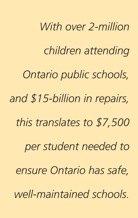
  • In Ontario, all 72 public school boards have repair backlogs, for a total of over $15-billion of outstanding repairs – many of which are deemed “urgent” by the Province.
  • In Montreal, almost 40% of the 226 schools in one board were recently deemed to be in either an “excessive [or] advanced state of decay”.
  • In New Brunswick, two public schools had to be closed in 2010 because they were unsafe, forcing that provincial government to invest more in school buildings.

The 5-million children who attend Canadian public schools deserve better – as do the countless Canadian children who attend childcare programs in these same schools. Voters across the country consider their local public schools to be community hubs, and expect these buildings to be safe, well-maintained, and funded as critical social infrastructure.

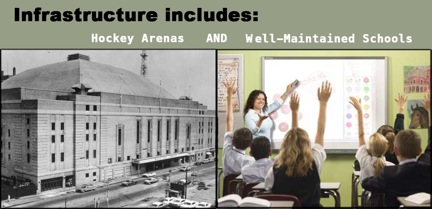
Federal infrastructure money has been used for hockey arenas, curling rinks and gazebos. Surely, Canadians would agree that federal investment in school buildings is equally important? So, our question to the Federal parties is this:

How much federal infrastructure money would your party invest in repairing and rebuilding Canadian public school buildings – a critical part of our country’s infrastructure?

Kind regards,

Krista Wylie – Co-Founder, Fix Our Schools

www.fixourschools.ca: grassroots, non-partisan advocates for safe, well-maintained schools

Barbara Hall’s TDSB Report – where is it?

Both Toronto dailies have printed concerns about when the Barbara Hall report on the TDSB is going to be released. The Toronto Sun printed “Ontario Liberals Sitting on TDSB Report” on Sept. 6 and the Toronto Star printed “Release Report on School Board Now” on Sept. 11.

Back in mid-July, Fix Our Schools followed up with this letter to the TDSB Governance Panel. We know that Barbara Hall and her colleagues have submitted the report to Premier Wynne and Minister Sandals. However, we do not yet know what is in that report because the province appears to be sitting on the report. Speculation abounds as to why this is the case. Could it be the ongoing labour negotiations that are preventing the release of this report? Could it be the federal election? Could it be the Province doesn’t like what is in the report? Anybody’s guess really.

We continue to hope that any recommendations made by the TDSB Governance Panel will:

• get to the heart of the issues at the TDSB

• respect the fact that this new board of Trustees has had scant time to actually govern

• keep the best interests of TDSB students and families in mind

In a world of finite resources, what would you choose?

Olympic_rings_(7662576984)As Co-founder of the Fix Our Schools campaign, I just hit “send” on this letter to the Editor at the Globe & Mail:

Dear Editor,

Please accept the following submission in response to the Editorial entitled, “The 2024 Toronto Olympics? No thanks.” 

In a world of finite resources, I’d invest in the children of this city

My son wore his winter coat at school this past winter because his classroom was 12-degrees. Last week, countless Toronto children would have worn as little as possible to cope with 38-degree heat and no air conditioning in their 50-100-year old schools.

To repair and rebuild Toronto’s public schools would cost between $4-6-billion. This investment would benefit over 350,000 children across four school boards, who spend 6 hours/day, 5 days/week, 10 months/year in buildings that all too frequently provide sub-standard learning environments.

To host the 2024 Summer Olympics would also cost between $4-6-billion. As much as I love the Olympics, in a world of finite resources, I would choose to invest in the children of this city. Let’s fix our schools.

Kind regards, Krista Wylie

In a world of finite resources, what would you choose?

New Brunswick: what investing in school infrastructure looks like!

“Canada is one of the best countries in the world in which to get an education”, according to a recent report issued by Environics Canada. Despite this glowing commendation, school buildings across the country have been left to crumble in recent years.

Let’s have a look at New Brunswick public schools, which serve approximately 87,000 students – and which hit a crisis point in December 2010…

Two public schools had to be shut down due to health and safety concerns – a huge wake-up call for the Progressive Conservative provincial government that was in power at that time. In response, Education Minister Jody Carr announced $98.3 million in funding to upgrade and build new schools, the largest capital budget ever for New Brunswick’s Ministry of Education at $1,100 per student – and an important investment in the children of that province.

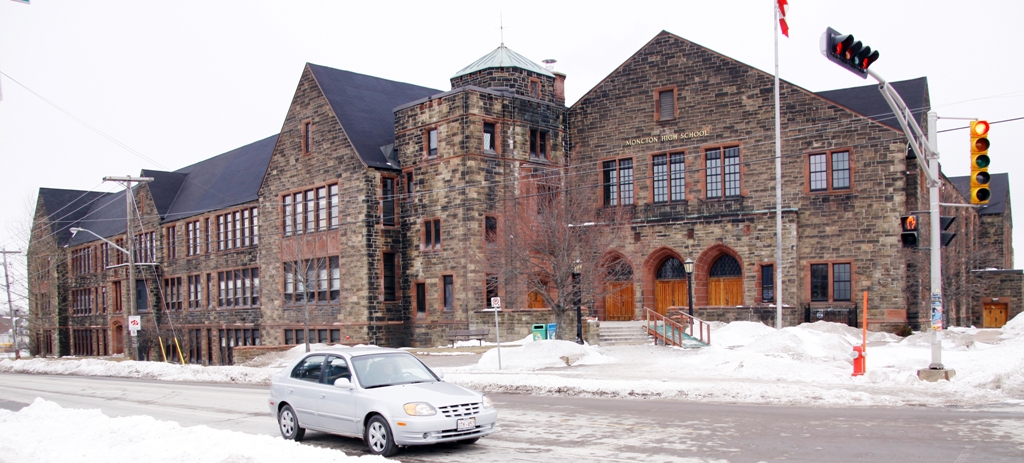
This investment allowed for Moncton High School to be rebuilt. 2015_09_09_New Moncton High SchoolArguably, had the original school been well-maintained over the years, it could still be serving the community. 2015_09_09_Old Moncton H.SHowever by 2010, the building was unsafe for students and the cost of restoring the original building outweighed the cost of rebuilding from scratch.

After reflecting on how New Brunswick schools had reached the crisis point of actually having to close public schools because they had become unsafe, Education Minister Carr concluded that provincial governments had not spent enough to keep schools well-maintained. 

“It was clear to me that successive governments have not worked hard enough to fund, maintain and repair our aging school buildings,” Carr said in his budget speech. “I’m also convinced that we need to better prioritize, plan and manage school upgrades across our province,” he said.

Fast forward four years to December 2014…

With a Liberal provincial government now in power in New Brunswick, Education and Early Childhood Development Minister Serge Rousselle announced another large investment of $95.9-million (another $1,100 per student!) in maintaining, fixing and rebuilding public schools across the province.

“New Brunswick’s public schools must continue to offer safe and healthy environments that meet the needs of students, teachers and staff,” Rousselle said. “This significant investment in educational infrastructure will result in new and enhanced schools that will support students as they continue their journey of learning.”

How does this compare to Ontario? NB Sidebar

If Ontario were to invest $1,100 per student this year into school infrastructure, that would translate into $2.2-billion. Our provincial government is investing nowhere near that amount in Ontario’s school infrastructure. In fact, only $250-million was allocated to School Condition Improvement in 2014-15 and $500-million was allocated in 2015-16. Premier Wynne and Minister Sandals – are you listening? Let’s start to make a real investment in Ontario’s school infrastructure.


Lots of work done over the summer at Ontario public schools!

According to TDSB Ward 11 Trustee Shelley Laskin’s recent e-newsletter, lots of work has happened this past summer to improve the state of TDSB schools, including 118 roofing projects across TDSB schools since March. If you have examples of work that was done at schools near you – no matter where you live in Ontario – please share with us.

Below is a detailed list of the many facilities projects that were completed in TDSB Ward 11 schools over the summer, which is just a small glimpse into all the facilities projects that were completed across all 72 Ontario public school boards:

  • JR Wilcox received solar panels on its roof.
  • Renovations to increase the number of available classrooms were undertaken at Brown, Deer Park and McMurrich.
  • The field was re-sodded at Davisville and the turf was repaired at Maurice Cody.
  • Brick work was done at Deer Park
  • Stairs were repaired at McMurrich as well as at Northern.
  • Northern also had issues with its hot water tanks and they are being replaced.
  • FHCI had its pool repaired and significant repairs to the pool at Deer Park should be completed by the end of October.
  • Caretaking staff worked diligently over the summer cleaning and polishing and mowing.

A good reminder that a lot of work does get done over the summer at our children’s schools! Still a lot to do to deal with $15-billion of needed repairs in Ontario’s public schools but encouraging to hear specific projects nonetheless.

How much money will go to repairing and rebuilding Canada’s public schools?

The federal election got really interesting this past week when the Liberals announced they would increase infrastructure funding even if it meant running a deficit for the next three years.

So the question is, “How much federal infrastructure money will go to repairing and rebuilding Canada’s public schools?”

Schools across this country are in an unacceptable state of repair and must be fixed. Federal dollars could help.

According to the Liberal platform, their government would “provide a new, dedicated funding envelope for social infrastructure” and would “prioritize investment in affordable housing and seniors facilities, early learning and child care, and cultural or recreational infrastructure.

hockey arenasSurely, public schools are key social infrastructure in this countryChildcare and early learning most often occurs in public schools so using federal infrastructure money to ensure these buildings are in good condition makes a lot of sense! And, finally, if federal dollars can go towards recreational infrastructure like hockey arenas, surely they can go towards fixing public schools?

key Canadian value is to deliver a quality public education to our children. So remember to ask all federal candidates about allocating federal infrastructure to fixing public schools! 

Will community hubs help to “fix our schools”?

Will community hubs help to fix our schools? This remains to be seen…

This past spring, Kathleen Wynne appointed a nine-person Community Hub Framework Advisory Group, led by Special Advisor Karen Pitre, to review provincial policies and develop a framework for adapting existing public properties to become community hubs. The Advisory Group released “Community Hubs in Ontario: A Strategic Framework and Action Plan” on August 10. This report candidly points out that “provincial policies and processes are overly complicated, often fragmented and are driven by ministry-specific requirements rather than being viewed through a lens of community needs and outcomes.”

The report outlines many longer-term recommendations to overcome these barriers – such as the creation of a provincial “lead entity” to help build bridges between provincial ministries, municipalities, school boards, health agencies, employers, immigration services and recreation centres – all the players that can be involved in creating a community hub. The report also recommends a short-term strategy for schools for immediate implementation. Although Pitre is clear that “we’re not going to save all schools — this is not a save-the-school strategy”, she did point out that, “we may need a longer planning process, because once a public asset is lost, it’s gone for good.”

The Advisory Group was realistic about what its report could accomplish and urged the Province to consider it the “beginning of a sustained conversation between communities, municipalities, local groups and the Province”.


TDSB Chair Robin Pilkey on Community Hubs

On August 10, the provincially appointed Advisory Group led by Karen Pitre issued a report entitled, “Community Hubs in Ontario: A Strategic Framework and Action Plan”.

On August 12, the TDSB elected new Chair Robin Pilkey, who made the following comments about the Community Hubs report in her acceptance speech:

Just this week, we have received the report and recommendations of the Premier’s Community Hubs Framework Advisory Group. At first glance, the advisory group seems headed in the right direction. The TDSB has been a leader in creating community hubs in our schools.

But our experience tells us that the promise of community hubs will require radical change in provincial funding to support community services and activities in schools. 

The report is also a reminder to all of our community partners that where and when it makes sense to close or sell a school, the TDSB must receive fair compensation as we continue to face pressing needs to repair our schools and in some cases build more school space where enrolment is booming.

That being said, the TDSB looks forward to participating in the creation of a new provincial framework for the community use of schools.

CTV features growing TDSB repair backlog

CTV featured August 14 as a “sad day for the TDSB” – the day when the repair backlog in its schools grew to exceed $3.5-billion.  Trustee Ken Lister has been tracking the growing repair backlog on his website and CTV felt it was important to highlight this issue (again!) for its viewers to mark this “dubious milestone”. CTV approached Fix Our Schools for photos of disrepair so you may see a photo that you sent to us in the TV clip.

What was not included in the TV clip above were a lot of the details below – which didn’t make it to air!

The Province provides the funding for maintaining schools. Under their watch, $3.5-billion of disrepair has accumulated in TDSB schools and $15-billion of disrepair has accumulated in public schools across the province. Every single one of Ontario’s 72 school boards has a repair backlog.

– While many people blame Principals and Trustees for the disrepair in our schools, the funding for maintaining schools comes from our provincial government. School boards must strive to be as efficient and effective as possible with the money provided by the Province. However, over the past 20 years, there simply has not been sufficient money provided by our provincial government to ensure our public schools are kept in good repair.

In 2014-15, the province provided only $2.27 to the TDSB for every $100 of repairs needed. No matter how efficient or effective a school board is, there is simply no way that $100 of disrepair can be fixed with $2.27!

– For 2015-16, the Province has substantially increased its funding to school boards for maintenance, acknowledging that the $15-billion of disrepair in Ontario’s public schools is a problem. However, even with this large increase in funding, TDSB Trustees and Staff will have to figure out how to fix $3.5-billion of repairs with about $156-million – the equivalent of less than $5 for every $100 of much-needed repairs. This is clearly an impossible task and so the repair backlog in our children’s schools will continue to grow.

The time is now for the Province to acknowledge public schools as a critical part of our societal infrastructure and start working with school boards to find ongoing, sustainable sources of funding to ensure that children and communities benefit from public schools that are well-maintained.

New TDSB Chair sees collaboration as key

Robin Pilkey, a Professional Chartered Accountant, became Chair of Canada’s largest school board this week. She is optimistic about the TDSB’s ability to meet the challenges that lie ahead and sees collaboration – with TDSB Staff, with the Province, and with parents – as key.

In her acceptance speech on August 12, Pilkey noted that TDSB Trustees have a responsibility to work closely with TDSB Staff to deliver high quality education in a financially responsible manner. Pilkey also mentioned the importance of the TDSB’s relationship with the provincial government, noting that the Province must work with the TDSB to ensure a sustainable financial base for our public education system. The Ward 7 Trustee also noted the importance of parent advocacy, citing the parent-led Fix Our Schools campaign as having made an incredible contribution towards the improvement of provincial funding for school repairs.