Author Archives: admin

Ventilation Continues to be a Big Concern in Ontario Schools

The SickKids’ report entitled, “COVID-19: Guidance for School Reopening”  was first released on June 17, 2020. Fix Our Schools noted with interest that ventilation was cited as an important element of a safe return to school, and so began to ask citizens to submit concerns about ventilation in their local schools.

We have heard from dozens of parents, educators and education workers across the province with a myriad of issues pertaining to ventilation, including classrooms without windows, windows that do not open at all or that only open a tiny bit, and some older schools and portables without HVAC systems to bring in fresh air from outside, and have presented details in the table below.

We urge you to contact your local MPP (we’ve provided emails below) and also Premier Ford (premier@ontario.ca) and Minister Lecce (stephen.lecce@pc.ola.org) to voice your concerns about ventilation in your local schools, and to urge this provincial government to provide the funding actually needed for publicly funded schools to open their doors safely in a few short weeks.

School Board Ventilation Issue MPP Riding Party
Tom Thomson School HDSB Classrooms with windows only at ceiling
Windows do not open
Some shared spaces with no windows
Hon. Jane McKenna
email: jane.mckenna@pc.ola.org
Burlington PC
Mohawk Gardens Public School HDSB Most classrooms without windows
Some classrooms with tiny windows up high
Hon. Jane McKenna
email: jane.mckenna@pc.ola.org
Burlington PC
Central Public School HDSB Poor ventilation Hon. Jane McKenna
email: jane.mckenna@pc.ola.org
Burlington PC
John T. Tuck Public School HDSB Windows on top floor barely open
Office spaces with no windows
Hon. Jane McKenna
email: jane.mckenna@pc.ola.org
Burlington PC
Tait St. Public School WRDSB Windows don’t fully open Hon. Belinda C. Karahalios
email: belinda.karahalios@pc.ola.org
Cambridge PC
Kars on the Rideau Public School OCDSB Poor ventilation
Poor air circulation
Air has a musty smell
Hon. Goldie Ghamari
email: goldie.ghamari@pc.ola.org
Carleton PC
Mount Hope School HWDSB Upper level windows do not open
Lower level windows barely open
Hon. Donna Skelly
email: donna.skelly@pc.ola.org
Flamborough-Glanbrook PC
Earl of March Secondary School OCDSB Interior classrooms without windows
Poor ventilation system
Hon. Merrilee Fullerton
email: merrilee.fullerton@pc.ola.org
Kanata—Carleton PC
Kemptville Public School UCDSB Brand new building has windows that don’t open and class with no window at all Hon. Steve Clark
email: steve.clark@pc.ola.org
Leeds—Grenville—Thousand Islands and Rideau Lakes PC
Harry Bowes PS YRDSB Windows barely open
Poor air circulation
Hon. Paul Calandra
email: paul.calandra@pc.ola.org
Markham—Stouffville PC
Randall Public School YRDSB Kindergarten class windows won’t open Hon. Logan Kanapathi
email: logan.kanapathi@pc.ola.org
Markham—Thornhill PC
Forest Glen Public School PDSB Windows barely open Hon. Kaleed Rasheed
email: kaleed.rasheed@pc.ola.org
Mississauga East—Cooksville PC
Gladys Speers Public School HDSB Windows that don’t open
Windows that barely open
Hon. Stephen Crawford
email: stephen.crawford@pc.ola.org
Oakville PC
Center Wellington District High School UGDSB Windows don’t open
A/C functions poorly, or is not turned on
Classrooms on 3rd floor reach 40°C
Hon. Ted Arnott
email: ted.arnott@pc.ola.org
Wellington-Halton Hills PC
Crescent Town School TDSB Five classrooms with no windows Hon. Rima Berns-McGown
email: RBerns-McGown-QP@ndp.on.ca
Beaches—East York NDP
Gledhill Junior Public School TDSB No ventilation
Classroom sink doesn’t work
Hon. Rima Berns-McGown
email: RBerns-McGown-QP@ndp.on.ca
Beaches—East York NDP
D A Morrison Middle School TDSB Air system does not move air well around building: poor heathing & cooling
NONE of the classrooms have windows that open.
Changes to building (from open concept) lead to poor air circulation
Hon. Rima Berns-McGown
email: RBerns-McGown-QP@ndp.on.ca
Beaches—East York NDP
St. Thomas Aquinas Secondary School DPCDSB Windows only open 3-4 inches
There are only 2 windows per classroom
Many rooms do not have screens
HVAC malfunctions
Hon. Gurratan Singh
email: GSingh-QP@ndp.on.ca
Brampton East NDP
École secondaire Toronto Ouest (shares building with Saint-Frère-André) CSViamonde Classrooms without windows
A/C is ancient, not working
Sewage system malfunctions
Hon. Marit Stiles
email: MStiles-QP@ndp.on.ca
Davenport NDP
École secondaire catholique Saint-Frère-André CSC MonAvenir No classrooms with windows
A/C is ancient, not working
Sewage system malfunctions
Hon. Marit Stiles
email: MStiles-QP@ndp.on.ca
Davenport NDP
Regal Road Public School TDSB No screens
Windows on south side need replacing
Windows that don’t open
Hon. Marit Stiles
email: MStiles-QP@ndp.on.ca
Davenport NDP
Westdale Secondary School HWDSB Windows barely open, or not at all
Year round, building has extreme temperatures
Hon. Sandy Shaw
email: SShaw-CO@ndp.on.ca
Hamilton NDP
Yorkview Elementary School HWDSB Extreme heat, poor air flow in classrooms and no air conditioning Hon. Sandy Shaw
SShaw-CO@ndp.on.ca
Hamilton NDP
Dundana Elementary School HWDSB Extreme heat, poor air flow in classrooms and no air conditioning Hon. Sandy Shaw
SShaw-CO@ndp.on.ca
Hamilton NDP
Memorial City Elementary School HWDSB Dust coming out of the ventilation system
Windows difficult to open
Windows barely open (3 inches)
Hon. Andrea Horwath
email: horwatha-qp@ndp.on.ca
Hamilton Centre NDP
Parkdale School HWDSB Some windows don’t open Hon. Paul Miller
email: pmiller-qp@ndp.on.ca
Hamilton East – Stoney Creek NDP
Kingston Collegiate & Vocational Institute LDSB Windowless classrooms
Windows that don’t have the mechanisms to remain propped open
Students moving this winter to a new school that doesn’t have windows that open
Hon. Ian Arthur
email: IArthur-QP@ndp.on.ca
Kingston and the Islands NDP
St. John Catholic Elementary WCDSB Basement classrooms with windows that don’t open
Poor ventilation system
Hon. Laura Mae Lindo
email: LLindo-QP@ndp.on.ca
Kitchener Centre NDP
Clarke Road Secondary School TVDSB Classrooms with no windows
Hall windows are screwed shut
Hon. Teresa J. Armstrong
email: tarmstrong-qp@ndp.on.ca
London—Fanshawe NDP
Humberside Public School TDSB Windows barely open
Windows require textbooks to prop open
Unbearably hot year round
School has no fans
Hon. Bhutila Karpoche
email: BKarpoche-QP@ndp.on.ca
Parkdale-High Park NDP
Western Technical Commercial School TDSB Windows have broken frames & cranks Hon. Bhutila Karpoche
email: BKarpoche-QP@ndp.on.ca
Parkdale-High Park NDP
Island Public school TDSB Classrooms with no windows Hon. Chris Glover
email: CGlover-CO@ndp.on.ca
Spadina—Fort York NDP
École Élémentaire Immaculée Conception CSC MonAvenir Old building, poor ventilation
Shared with another school
Hon. Jennifer Stevens
email: JStevens-QP@ndp.on.ca
St. Catharines NDP
Holy Trinity Catholic Elementary School SCDSB Kindergarten class with no windows Hon. Jamie West
email: JWest-QP@ndp.on.ca
Sudbury NDP
Lo-Ellen Park Secondary School RDSB Classrooms with one small window that barely open
Science classroom with tiny window, no venting
Hon. Jamie West
email: JWest-QP@ndp.on.ca
Sudbury NDP
Winchester Public School TDSB Half of school building has ancient windows Hon. Suze Morrison
email: SMorrison-QP@ndp.on.ca
Toronto Centre NDP
Roden P.S. TDSB Windows that do not open Hon. Peter Tabuns
email: tabunsp-qp@ndp.on.ca
Toronto—Danforth NDP
Equinox Alternative School TDSB Windows that do not open Hon. Peter Tabuns
email: tabunsp-qp@ndp.on.ca
Toronto—Danforth NDP
Holy Name Catholic School TCDSB Old windows with faulty mechanisms
Radiators, not enough ventilation
Stops on windows mean they only open 2-3″
Hon. Peter Tabuns
email: tabunsp-qp@ndp.on.ca
Toronto—Danforth NDP
RH McGregor Elementary School TDSB No windows that open in entire school
School is open concept with no walls
School is attached to a medical building
Roof leaks
Hon. Peter Tabuns
email: tabunsp-qp@ndp.on.ca
Toronto—Danforth NDP
Duke of a Connaught Public School TDSB The windows barely open (open diagonally to about 30 degrees)
Unbearable heat year round
Hon. Peter Tabuns
email: tabunsp-qp@ndp.on.ca
Toronto—Danforth NDP
Bruce Public School TDSB Windows barely open Hon. Peter Tabuns
email: tabunsp-qp@ndp.on.ca
Toronto—Danforth NDP
York Humber High School TDSB Windows are locked closed
HVAC constantly breaking down
Hon. Faisal Hassan
email: FHassan-QP@ndp.on.ca
York South—Weston NDP
St. Anselm Catholic School TCDSB Old windows with faulty mechanisms
Radiators, not enough ventilation
Hon. Kathleen O. Wynne
email: kwynne.mpp.co@liberal.ola.org
Don Valley West LIBERAL
Carson Grove Elementary School OCDSB Windows don’t open
Some classrooms have no windows
Hon. Lucille Collard
email: LCollard.mpp.co@liberal.ola.org
Ottawa-Vanier LIBERAL
Ecole Gron Morgan Public School LDSB Poor ventilation
Extreme temperatures during winter
Hon. Michael Gravelle
email: mgravelle.mpp.co@liberal.ola.org
Thunder Bay—Superior North LIBERAL
Duncan J Schoular Public School UCDSB Design for school was to have a/c installed, so few windows, no real ventilation Hon. Randy Hillier
email: RHillier-CO@ola.org
Lanark—Frontenac—Kingston INDEPENDENT

Comments and issues presented in the table above have been submitted to Fix Our Schools from citizens, and have not been verified by Fix Our Schools.

In an August 15, 2020, Toronto Star article by May Warren entitled, “What you need to know about ventilation as Ontario prepares for back to school in the age of COVID-19“, Jeffrey Siegel, a professor of civil engineering at the University of Toronto states that “ventilation is all about bringing outdoor air in” but that people frequently confuse ventilation with filtration, which removes particles from the air that may contain COVID-19. Siegel notes that ventilation is much more important than filtration in reducing the spread of COVID-19, and that outdoor spaces seem to be the safest place to be, relative to COVID-19. One temporary solution for Ontario’s return to school plan would be to hold outdoor classes where possible. 

Seigel also raises the important point that HVAC systems in Ontario’s schools have been neglected for decades and require ongoing investments in order to be there when we need them the most – as in the case of a global pandemic! Premier Ford and all future provincial governments – please take note! Ongoing regular maintenance to ensure our infrastructure is in good working order is not a “nice to have” – it is a fiscal and health imperative.

In the same Toronto Star article, Fix Our Schools responded to Education Minister Lecce’s new allocation of $50-M for HVAC improvements in Ontario’s schools by saying this investment was “too little too late”. Krista Wylie, co-founder of Fix Our Schools noted that this investment only amounts to roughly $10,000 per school and that there were only a few weeks until schools are to reopen, leaving many classrooms in the position of likely being poorly ventilated this September.

Finally, the August 15 Toronto Star Article provides some vivid visuals about what bad, good and best classroom ventilation/airflow scenarios would look like, so be sure to check in with your children, teachers and education workers to find out what the scenario is like in their environment, once classes resume. Depending on what you discover, contact your local MPP and also Premier Ford (premier@ontario.ca) and Minister Lecce (stephen.lecce@pc.ola.org) to voice your concerns and urge this provincial government to provide the funding actually needed for schools to be the safe, healthy, well-maintained buildings that they ought to be.

Classroom airflow scenarios

Bad

Either windows don’t open or there are no windows so no fresh air is coming in. The heating ventilation and air conditioning (HVAC) system is not working, or hasn’t been adjusted to bring in more outside air. There may be no HVAC system.

Better

Opening windows is ideal to get air flowing. If there are no windows, you can bring in portable air filters. HVAC systems, if they exist, should be adjusted to increase fresh airflow and reduce re-circulation. Filters should be changed frequently. Desks should be spaced 2 metres apart.

Best

If possible, classes could be held outside in the fresh air.

MCKENNA DEIGHTON

“Unlocking” $500-M Sounds Great But Don’t Be Fooled

On Thursday, August 12, 2020, Education Minister Lecce announced that he was “unlocking” $500-M to help ensure a safe return to school in September. Sounds great at first blush – right? New provincial funding of a half-billion dollars to help ensure a safe return to school would, indeed, be great news. However, that is not what happened. In fact, zero new provincial dollars were allocated to funding public education and schools in Ontario when Minister Lecce performed his latest sleight of hand and “unlocked” $500-million dollars. 

What actually happened is that our provincial government gave school boards permission to access their reserve funds – or their “rainy day funds” as Premier Ford likes to call them.

What actually happened is that school boards are now being publicly pressured to use their reserve funds, which are all earmarked for future financial commitments or projects, to fund what ought to be funded by our provincial government in the form of new money to address serious concerns with the province’s back to school plan.   

What actually happened is that our provincial government shirked its responsibility to properly fund a safe return to school in September and downloaded that responsibility to local school boards, which have no way to generate revenue except to rely upon provincial funding.

Since 2014, Fix Our Schools has been calling on successive provincial governments to provide adequate, stable funding required to ensure safe, healthy, well-maintained school buildings that provide environments conducive to learning and working. Amidst a global pandemic, this call to action seems even more necessary. Premier Ford and Minister Lecce, will you prioritize the safety and well-being of 2-million students, teachers, and education workers in this province and commit the funding that is actually needed at this time by using your “rainy day” funds?

A Safe Back-to-School Plan Acknowledges Ontario Schools had $16.3-B of Disrepair Pre-Pandemic

As Fix Our Schools has maintained since 2014, our publicly funded schools are critical infrastructure. However, successive provincial governments have allowed $16.3-billion of disrepair to accumulate in these buildings over the last several decades. Therefore, even before the COVID pandemic, these critical public buildings were not providing an optimal environment for learning and working, nor were they always safe, healthy, or well-maintained. But the pandemic has certainly emphasized how critical our public school buildings are to the delivery of quality education, and to the safety and health of students, teachers, and education workers. All of a sudden, issues like good classroom ventilation are at the forefront of plans for a safe return to school.

In a conversation with Dahlia Kurtz on CFRA 580 on her radio program called “The Goods” on Sunday, August 2, Krista Wylie, co-founder of the Fix Our Schools campaign, shared the roots of disrepair in Ontario’s schools. She also provided some insights on what is needed to ensure a not only a safe return to school in September amidst a global pandemic but also safe, healthy, well-maintained school buildings as part of standard protocol in public education in Ontario.

When will the Ford Government Commit the Funding Actually NEEDED for a Safe Return to School

While the Ford government continues to tout Ontario’s back-to-school plan as safe, the consensus among parents, teachers, local public health authorities, and others is that additional provincial funding is needed.

On August 5, 2020, the Federal Minister of Infrastructure and Communities Catherine McKenna announced that the Canada Infrastructure Program was being adjusted so that provinces and territories can use federal funding to act quickly on a wider range of more pandemic-resilient infrastructure projects, including retrofitting schools to allow kids to go to school safely. This funding stream could be worth up to $3.3-billion.

Usually, provincial funding is the only source of money for investment in Ontario’s publicly funded school buildings so this is a welcome source of new funding!

We heard on August 7, 2020 that the Ford government, in partnership with the federal government, is providing $234.6 million in funding to keep children and staff safe in child care and early years settings to help pay for enhanced cleaning costs and health and safety requirements. Fix Our Schools is calling upon the Ford government to also commit additional funding to Ontario’s publicly funded schools to keep students, teachers and education workers safe in schools. Whether partnering with our federal government, digging into our own provincial coffers, or most likely – a combination of both – additional funding is a requirement for a safe return to school in Ontario.

Let’s Move Forward Assuming Premier Ford and Minister Lecce Meant What They Said!

A quick review of the last 10 days in public education in Ontario. It has been a whirlwhind!

On July 23, 2020, the Ministry of Education was very firm that there would be no additional funding to support COVID at this time.  

In the six days following that statement, a lot of political pressure came to bear on the Ford government:

  • Citizens across the province came together for a Day of Action on July 29th, visiting mant local MPP offices to demand a fully-funded, safe return to school.

And then on Thursday, July 30th, Minister Lecce and Premier Ford announced their plan for a return to school in September, along with a commitment of $309-million. While this amount is not nearly sufficient, Ford and Lecce also continued to pledge that they will do (and therefore spend) whatever is needed to keep students, teachers and education workers safe. Fix Our Schools is not alone in believing that all 72 Ontario school boards ought to move forward, assuming that Premier Ford and Minister Lecce meant what they said, to collaborate with their local public health units, teachers, principals, and education workers to develop the local plans they believe will be most successful.

As National Post columnist Chris Selley suggested in his August 1, 2020 column entitled, “Ontario school plan deserves a passing grade“, Ontario’s back-to-school plan could be more like successful back-to-school plans from other countries if school boards are given the resources they need. Selley also acknowledges that “the plan certainly could and should be more ambitious; its failure to mandate smaller class sizes or a minimum distance between students is conspicuous, in light of notably successful reopenings in Denmark and Norway — and in light of a report from doctors at Sick Kids Hospital in Toronto, which the government cites, that stressed the need for distancing. But there’s nothing in the plan that says schools can’t try to make the best of their individual situations. It’s at the local level that any plan fails or succeeds. Some might be able to install outdoor canopies on their sports fields, for example, to hold class outside even once summer is over. Some might have access to different kinds of nearby vacant space. Anything larger than your average at-capacity classroom would be beneficial, based on what we know, and I suspect the public would be happy to pay what it cost.

In his July 30th Toronto Star column entitled, “Doug Ford is right to send Ontario students back to school“, Martin Regg Cohn calls Premier Ford and Minister Lecce’s back-to-school plan “a work in progress, a sensible start in the long road to recovery, albeit short on key details — notably its financial underpinnings.” Regg Cohn also states that “there are gaps in the plan, but they are not gaping holes that cannot be plugged with political will, a little goodwill, and financial wherewithal” and notes that “the government’s initial blueprint lowballs the ultimate costs” but he, too, reminds us that the Premier has “pledged to do (and therefore spend) whatever it takes to keep students safe — don’t forget teachers — so he can’t duck when the bills come due.”

So, as school boards move forward and release more detailed local plans for a safe return to school in September, we look forward to hearing and seeing the details of the actual costs of those plans so that Premier Ford knows how much he will need to spend beyond his initial commitment of $309-million.

Ontario Liberals Estimate $3.2-B Additional Funding Needed for Safe Return to School

On Monday, the Liberal party of Ontario turned up the pressure on Doug Ford and Stephen Lecce to come to Ontarians with a concrete and costed plan for a safe return to school. Liberal Leader Steven Del Duca said, “since the government hasn’t unveiled a plan for the fall, I did.”

In the July 27, 2020 Toronto Star article entitled, “Opening Ontario schools safely amid COVID would require up to $3.2-billion in funding for staff, cleaning supplies say Liberals, staff union“, Del Duca said “students and their parents have been waiting for far too long to hear what will happen in September. Living with this uncertainty has caused unnecessary anxiety … Getting our students back to school safely is what kids critically need … and it’s the only way their moms and dads can have peace of mind to return to work.

The Ontario Liberals released their “Students in schools action plan”, calling on Ford and Lecce to allocate $3.2-billion of additional funding to cover anticipated expenses such as:

  • 17,000 additional teachers to reduce class sizes
  • 10,000 caretakers to keep schools clean and sanitized
  • 14,000 new classrooms in community centres, campuses, arenas, etc.
  • Sufficient cleaning/hygiene supplies and equipment
  • School transportation

Sadly, Ford and Lecce have continued to boast about the inadequate $1.4-B/year funding for school renewal and repairs. Shockingly, they have been urging school boards to tap into that funding to cover costs such as hand-sanitizing centres, and improving building ventilation. However, the $1.4-B/year of school renewal and repair funding has not even allowed Ontario’s school boards to stem the tide on a constantly increasing list of repairs in Ontario’s schools. The repair backlog in Ontario’s schools has ballooned from $15-billion to $16.3-billion over the years when annual funding has been $1.4-B/year – clearly proving that this funding is insufficient – even without the needs demanded by a global pandemic.

The Canadian Union of Public Employees (CUPE) also revealed cost estimates for a safe return to school in September based on their experience in other sectors that have continued working during the pandemic. Laura Walton, who heads CUPE’s school bargaining unit, said there needs to be a 2.1% increase in education spending for the coming year. CUPE’s estimate of an additional $1.49 per student per day (in sharp contrast to Doug Ford’s current proposal of an additional $0.07 per student per day) would total $590-million to pay for necessary items such as:

  • touch-free hand sanitizers in every classroom
  • sanitizer refills
  • PPE
  • Plexiglas for school offices and libraries
  • Opening up unused rooms in schools to accommodate smaller classes
  • Bringing in extra education assistants
  • Hiring one new custodian in each of the province’s 4,800 schools.

CUPE’s estimate of costs did not include the costs of hiring additional teachers to ensure smaller class sizes.

It is clear that there is a financial cost to our students, teachers, and education workers returning safely to schools this fall. As the Toronto Star Editorial Board shared on July 27, 2020 in their piece entitled, “Ontario’s back-to-school plan must come with cash“, “whatever the exact amount, it will be money well spent. As a society, we have to figure out a way to make the return to school both successful and safe. When the province unveils its back-to-school plan this week, it should also provide its own estimate of the cost — and assure Ontarians that it will find the money. Students, parents and educators deserve no less.

Who is Responsible for Funding Safe, Healthy Return to School for Ontario’s Children?

The schools that most Ontario children attend depend entirely on funding from the provincial government. However, the children of Ontario’s First Nations schools are funded at the whim of the federal government. In 2014, the Auditor General called for Canada to “immediately develop and implement a comprehensive strategy and action plan, with targets, to close the education gap.” This plan has not happened. Providing equal education to Ontario’s First Nations requires a commitment to adequate, stable funding.

Matawa First Nations Management, a council representing nine communities between the north shore of Lake Superior and James Bay (five of which are only accessible by air & winter road), has not received adequate funding to address a safe, healthy back-to-school this fall. 

These remote communities estimate they need $25-M in supplemental funding for all their educational facilities for this fall. These costs are in addition to the funding for Grandview Lodge, a dormitory-style school that will not only allow students to stay in the north, but will also allow their parents to stay for extended visits.

In Ontario’s First Nations communities, our federal government is obliged to fully fund appropriately-equipped schools and prepare all schools for this fall’s challenges. Prime Minister Trudeau… over to you.

Getting Children Back to School Has to Be Our Top Priority

As per the July 18, 2020 article in School Magazine entitled, “Re-opening schools in September – many loaded questions”, “in just over a month, roughly 2 million Ontario students may get ready to return to school after 6 months away from the classroom. But, in the light of COVID-19, it’s not at all clear how a safe return will work. There are a lot of factors in play, but the overriding one is money.” 

In a July 20, 2020 opinion piece in the Globe & Mail entitled, “Getting children back to school has to be our top priority“, André Picard states, “six months into the pandemic and six weeks shy of the traditional post-Labour Day return to school, the question we need to ask is not, “Should kids return to school?” The question we need to ask and answer is: How can we ensure that children return to school as safely as possible?“. Picard urges governments and school boards to stop dithering and propose clear reopening plans so that these plans can be debated, discussed and tweaked. Wisely, he concludes that “getting children back in the classroom, smartly and safely, has to be the number one priority of politicians, public-health officials, educators and parents alike. Bars, restaurants, hair salons, golf clubs and the like should all take a back seat to ensuring that children get an education – and a childhood – pandemic or not.”

Fix Our Schools agrees that provincial funding and leadership is key to ensuring children can return to school in September as safely as possible. Since June 1, Fix Our Schools has been calling on the Ford government to prioritize publicly funded schools and education and commit the funding required for a safe return to school. We urge you to assist in building the political pressure needed to make this happen.

Please mark July 29th on your calendar to visit your local MPP’s office at noon and demand a safe and fully funded return to school for Ontario’s students. Ontario Families for Public Education and the Ontario Parents Action Network are organizing this event and ask that you please register here.

When you connect with your local MPP, be sure to remind them that even prior to the COVID-19 pandemic, provincial funding for schools was grossly inadequate, allowing $16.3-billion of disrepair to accumulate in Ontario’s school buildings. Below, we’ve listed school disrepair details for PC ridings where local MPPs signed the Fix Our Schools Pledge during the last provincial election, committing personally to ensuring all Ontario schools are provided adequate funding to ensure they are safe, healthy, well-maintained and provide environments conducive to learning.

Now would be the perfect time to remind these MPPs of their commitment and to hold them to their election promise! And please be sure to point out that for a safe return to school amidst a global pandemic, school boards will need additional funding to ensure PPE availability, good ventilation in classrooms, reasonable classroom temperatures, proper hand hygiene and cleanliness, and sufficient caretaking staff, to name but a few details.

Andrea Khanjin: $36.2-M of disrepair in Barrie-Innisfil schools

Michael Parsa: $45.9-M of disrepair in Aurora-Oak Ridges-Richmond Hill schools

Bill Walker: $84.4-M of disrepair in Bruce-Grey-Owen Sound schools

Jane McKenna: $177.1-M of disrepair in Burlington schools

Vincent Ke: $191.5-M of disrepair in Don Valley North schools

Robin Martin: $181.7-M of disrepair in Eglinton-Lawrence schools

Kinga Surma: $281.6-M of disrepair in Etobicoke-Centre schools

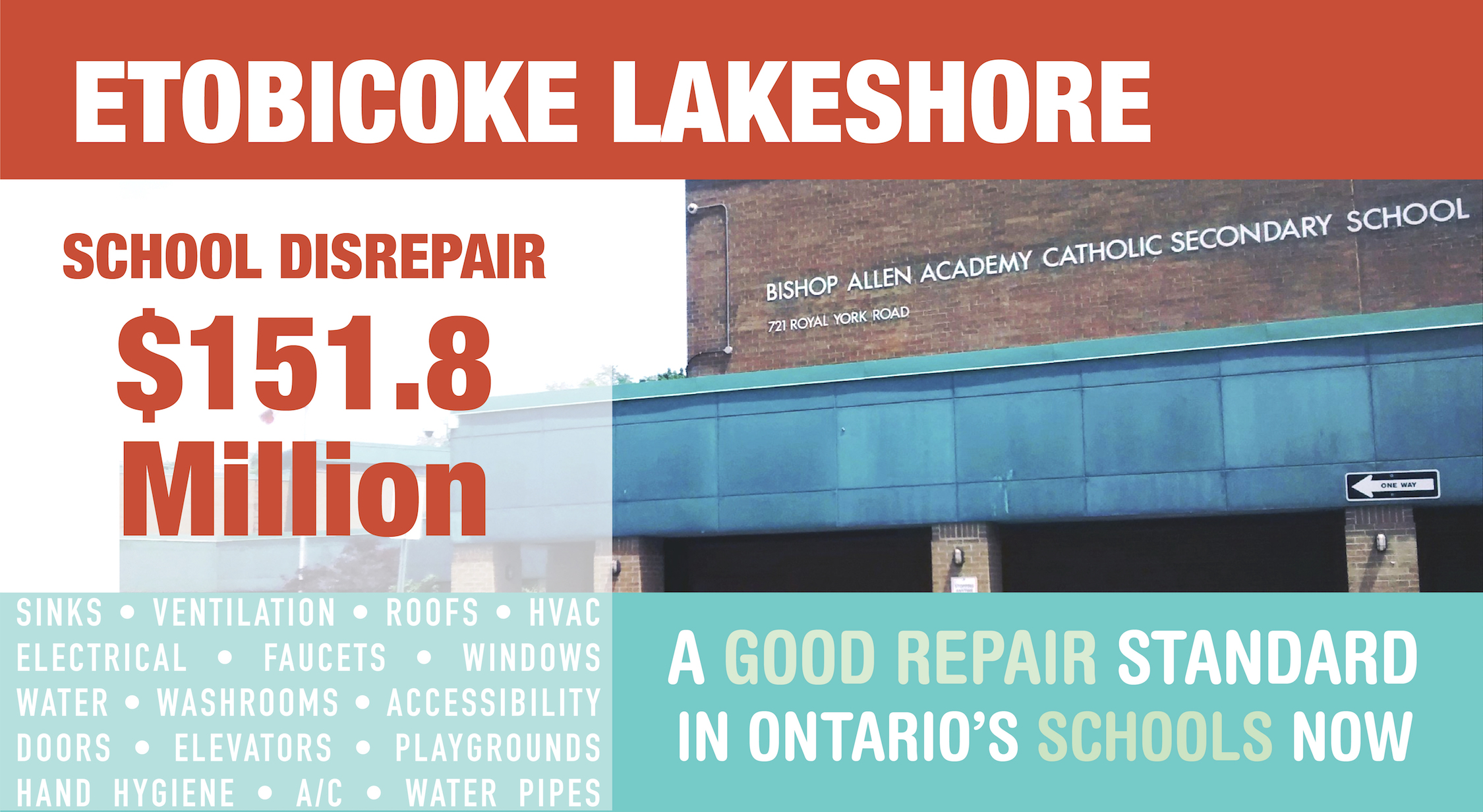
Christine Hogarth: $151.8-M of disrepair in Etobicoke-Lakeshore schools

Daryl Kramp: $115.9-M of disrepair in Hastings-Lennox-Addington schools

Lisa Thompson: $113.8-M of disrepair in Huron-Bruce schools

Natalia Kusendova: $113-M of disrepair in Mississauga Centre schools

Rudy Cuzzetto: $237.9-M of disrepair in Mississauga Lakeshore schools

Deepak Anand: $92-M of disrepair in Mississauga Malton schools

Vic Fedeli: $96-M of disrepair in Nipissing schools

Christina Mitas: $212.2-M of disrepair in Scarborough-Centre schools

Lorne Coe: $102.1-M of disrepair in Whitby schools

Stan Cho: $125-M of disrepair in Willowdale schools

Roman Baber: $171.2-M of disrepair in York Centre schools

Ontario’s education funding formula has allowed this gobsmacking amount of disrepair to accumulate in school buildings where your children spend their days. The COVID-19 pandemic has laid bare how critically important it is for a society to have schools that are safe, healthy, well-maintained buildings that provide environments conducive to learning and working. The COVID-19 pandemic has also made it clear that, with sufficient political will, previously unimaginable public resources can be found and allocated.

The time is now to demand that our provincial government prioritize public education and schools by providing the funding that is actually needed to ensure this critical public infrastructure is safe, healthy, well-maintained and offers environments conducive to learning and working. 2-million Ontario children, their families, their teachers, and the education workers who support them all deserve nothing less.

Demand a Safe and Fully Funded Return to School

Fix Our Schools urges every citizen in this province to demand a safe and fully funded return to school in September! Ontario Families for Public Education and the Ontario Parents Action Network are calling upon every parent, teacher, education worker, and citizen to visit their local MPP’s office between noon – 1 pm on Wednesday, July 29 to demand a safe and fully funded return to school.

Even prior to the COVID-19 pandemic, our provincial government grossly underfunded schools to the extent that $16.3-billion of disrepair had been allowed to accumulate in Ontario’s school buildings. Please consider that in a COVID-19 reality, items such as PPE, good ventilation, reasonable classroom temperatures, resources to ensure proper hand hygiene and cleanliness, sufficient caretaking staff, water-bottle filling stations all become items that are even more important for students, teachers and education workers to be safe and healthy in their place of learning/work.

For those of you who live in a riding with a PC MPP, we urge you to make a special point of pressuring your local MPP to ensure a safe, fully funded return to school. Mark July 29th at noon on your calendar now to visit your local MPPs office. Below, you will find school disrepair details for many PC ridings and we  will provide details for additional PC ridings later this week:

Doug Ford: $178.4-M of disrepair in Etobicoke-North’s schools

Stephen Lecce: $30.9-M of disrepair in King-Vaughan schools

Rod Phillips: $74.5-M of disrepair in Ajax schools

Christine Elliott: $72.1-M of disrepair in Newmarket-Aurora schools

Raymond Cho: $111.8-M of disrepair in Scarborough-North schools

Vic Fedeli: $96-M of disrepair in Nipissing schools

Merrilee Fullerton: $77.5-M of disrepair in Ottawa-Carleton schools

Ernie Hardeman: $118.8-M of disrepair in Oxford schools

Lisa MacLeod: $98.8-M of disrepair in Nepean schools

Monte McNaughton: $131.4-M of disrepair in Lambton-Kent-Middlesex schools

Lisa Thompson: $113.8-M of disrepair in Huron-Bruce schools

Jeff Yurek: $176.9-M of disrepair in Elgin-Middlesex-London

The provincial education funding formula has allowed this gobsmacking amount of disrepair to accumulate in buildings where children spend their days. The COVID-19 pandemic has revealed the criticality of safe, healthy, well-maintained school buildings that provide environments conducive to learning and working. The COVID-19 pandemic has also revealed that, with political will, previously unimaginable public resources can be found and allocated.

The time is now to demand that our provincial government prioritize public education and schools by providing the funding that is actually needed. The time is now for political will to be applied so that previously unimaginable public resources can be found and allocated to ensure all Ontario schools are safe, healthy, well-maintained buildings that provide environments conducive to learning and working. Adequate and stable provincial funding is imperative for a safe return to school amidst a global pandemic and, quite frankly, for always.

Public Education and Schools are Essential

Across North America, families are realizing that public education and schools are essential. In this July 6, 2020 article entitled, “Reopening Schools Was Just an Afterthought: Americans found out the hard way that education is essential infrastructure” by in The Atlantic, Juliette Kayyem noted that, “recent headlines have heaped scorn upon the values of a society that seemingly prioritized inessential businesses over schools. “We Have to Focus on Opening Schools, Not Bars,” The New York Times declared. “Close the Bars. Reopen the Schools,” piece in Vox implored. The hashtag #schoolsbeforebars is trending.”

Kayyem went on to state that in her opinion, “two things need to happen before students can go back to school: First, Americans and their elected representatives must consciously decide that children’s needs are worth accepting some additional risk. Second, states and communities must commit the money and effort necessary to reinvent education under radically changed circumstances. She worries that in the United States, at all levels of government, elected officials simply have not classified education as a crucial form of infrastructure in need of protection. 

In Canada, the situation seems similar relative to how our elected officials have prioritized public education and schools to date. In the Globe & Mail Editorial entitled, “In seven weeks, schools are supposed to reopen. So what’s the plan?”, published on July 10, 2020, the Globe’s editorial board stated that, “as society reopens, schools have not been the top priority they need and deserve to be” and that “more should have already been done to tackle the challenge of reopening schools, for the benefit of students, parents and the country as a whole.” They also noted that “if Canada can figure out how people can get a haircut, go shopping or share the waters of a public swimming pool, surely plans could already be in place for the start of school.” 

The Globe editorial board recognized that the minimal community transmission in Canadian communities in recent weeks ought to make the reopening of schools more viable. Quebec is one province that is going for it with plans to resume full-time schooling all the way through high school in September, with safety measures in place. 

Some parents in other provinces are also seeking a full-time return to school in September. On Saturday, July 11, 2020, scores of Ontario parents attended a rally at Queen’s Park to demand that Ontario’s government commit to reopening schools full-time in September, and commit to funding the required safety measures. On Friday, July 10, a group of Ontario parents copied Fix Our Schools on a letter they wrote to the Premier and Minister Lecce also asking for a commitment to prioritize a full-time return to school in September, and outlining a 30-point plan for consideration.

Trustees and local school boards in Ontario are also calling on the provincial government to prioritize public education and schools. In Toronto, TDSB Trustees Jennifer Story and Rachel Chernos Lin have been in the news this past week and have led the charge in getting a motion passed called “A reopening that works for schools, children and families.”

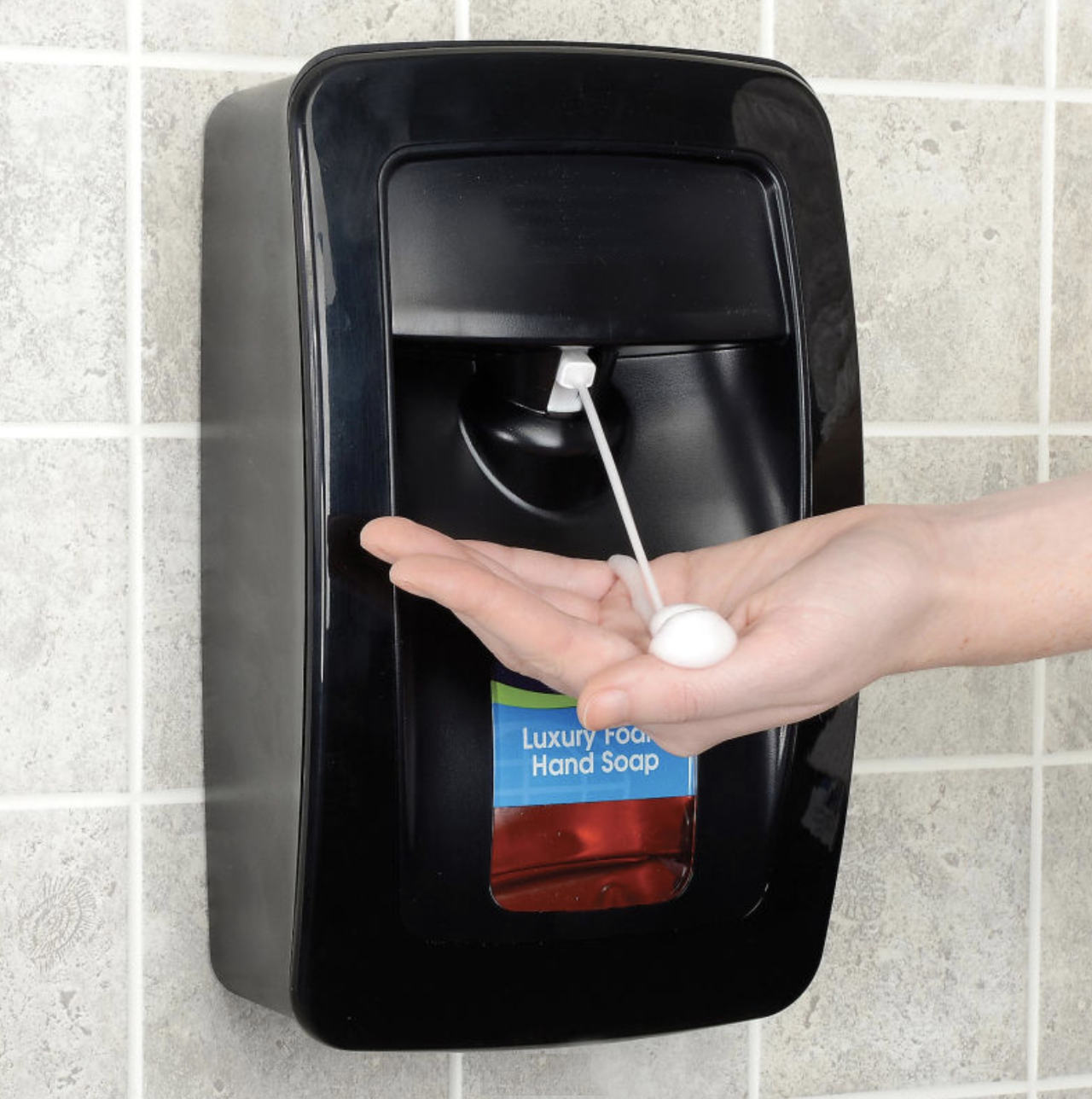
Among many urgent requests included in the motion, the TDSB has requested that our provincial government provide, as previously requested in our Board’s letter to the Minister of Education on May 22, 2020, the necessary funding supports to School Boards for all extra Covid-19 costs including PPE, additional staffing, additional transportation, IT devices, mental health and well-being supports, cleaning supplies and repair/maintenance including, but not limited to, ventilation issues, touch-free sinks and soap dispensers for handwashing, and water bottle refill stations“.

Fix Our Schools has collected information from parents, teachers, and education workers across the province about the current issues in Ontario classrooms relative to ensuring good ventilation. Sadly, many Ontario classrooms either do not have windows at all, have windows that do not open, or have windows that only open a tiny bit – hardly sufficient to ensure good ventilation.

In the coming weeks, Fix Our Schools is going to be turning our focus to the importance of Hand hygiene for a safe reopening of our schools in September. On June 19, Premier Ford and Education Minister Lecce provided us with their proposed “approach” for a safe return to schools in September that notes the following about hand hygiene:

  • Hand hygiene refers to hand washing or hand sanitizing to remove or kill the virus and is the most effective way to reduce the transmission of organisms.
  • Education: Staff and students should be provided with targeted, age-appropriate education in proper hand hygiene and respiratory etiquette. Local public health units can provide additional guidance. Age-appropriate posters or signage should be placed around the school.
  • Supplies: Staff and students should have the supplies they need to conduct appropriate hand hygiene and respiratory etiquette and these supplies should be easily accessible.
  • Alcohol Based Hand Rub (ABHR) with a minimum 60% alcohol concentration (60-90% recommended in community settings) throughout the school (including ideally at the entry point to each classroom) and/or plain liquid soap in dispensers, sinks and paper towels in dispensers.
    • Soap and water are preferred as it is the most effective method and least likely to cause harm if accidentally ingested
    • ABHR can be used by children. It is most effective when hands are not visibly soiled
    • For any dirt, blood, body fluids (urine/feces), it is preferred that hands be washed with soap and water to remove this “organic material”
    • Safe placement of the ABHR to avoid consumption is important, especially for young children
  • Tissues and lined, no-touch waste baskets (i.e., foot pedal-operated, hand sensor, open basket).
  • Support or modifications allowing students with special needs to regularly perform hand hygiene as independently as possible.
  • Hand hygiene should be conducted by anyone entering the school and incorporated into the daily schedule at regular intervals during the day, above and beyond what is usually recommended (e.g., before eating food, after using the washroom).
  • Possible options would be to have regular scheduled hand hygiene breaks based on a pre-specified schedule
  • Students may need assistance or supervision

Unfortunately, the sad fact is that much work has to be done in the coming weeks to ensure students, teachers, and education workers are able to practice the hand hygiene required. For instance, let’s consider only the one aspect noted above on hand sanitizer. The provincial government has recommended that hand sanitizer stations are available at the entry point of every classroom and, presumably would like those stations filled all the time with hand sanitizer. However, no provincial funding has been allocated to said measure.


If we only consider the cost of the actual hand sanitizer and don’t even consider the cost of the initial installation of hand sanitizer stations and regular maintenance and refilling of said stations, we think a very conservative estimate is that each Ontario student might use $2 of hand sanitizer each month. If we extend that to covering the cost of hand sanitizer for 2-million students for 10 months of the year, we quickly arrive at a yearly cost of $40-million – just for hand sanitizer.

If you are a student, parent, teacher or education worker with concerns about how proper hand hygiene will be achieved in September, we would like to hear from you with the name of your local school, the hand hygiene issue you are concerned about and if you know your local MPP and/or the name of your provincial riding, that would be great too! Please contact us today to share any concerns you have about your local school being able to ensure that all students, teachers and education workers will be able to practice proper hand hygiene in September to help avoid the spread of COVID in classrooms.

Provincial funding should be flowing immediately to school boards to ensure proper hand hygiene is achievable for September. Regardless of the model that ends up being adopted for back-to-schools, every school in the Province must ensure that soap dispensers are secure and in good working order, and that hand sanitizer stations are installed at all entry points to the school and to each classroom. If the Province believes that its ongoing $1.4-billion/year capital investment will be sufficient for school boards to find money in their capital budgets to conduct these types of projects in the coming two months, then the Province is being disingenuousThe repair backlog in Ontario’s publicly funded schools has continued to increase to a whopping $16.3-billion even with yearly investments of $1.4-billion/year since June 2016. School boards often end up only having sufficient funding to deal with reactive repairs and not the proactive repairs required – especially in a global pandemic. We look forward to hearing from you!