Category Archives: Fix Our Schools

Ventilation in Ontario’s Schools: Update

Ventilation is a key aspect of keeping people safe during the COVID-pandemic. With schools opening soon for in-person learning for the first time in many months, amidst what has been confirmed to be the fourth wave of the COVID-pandemic in Ontario, ventilation in schools is understandably a hot topic.

The August 13, 2021 Toronto Star article by Sarah Mojtehedzadeh and May Warren entitled, “Many major school ventilation upgrades won’t be ready by September. Here’s what you need to know about the precautions in place” does an outstanding job of providing details on what to expect at schools in various school boards across the province relative to ventilation this September. The Toronto Star team contacted all 72 Ontario school boards to ask for details on ventilation improvements and upgrades in their schools, and heard back from 30 school boards.

We applaud the transparency and candour of these 30 school boards who responded to the Toronto Star. Fix Our Schools has also been so appreciative of school boards such as the Hamilton Wentworth District School Board (HWDSB)  and the Toronto District School Board (TDSB), that are being transparent on a school-by-school basis about ventilation, and also endeavouring to educate us about the complexities of ventilation.

If you do not see your local school board’s ventilation details in the Toronto Star report, nor are you able to find ventilation details on your school board’s website, please contact your local Trustee and Chair to let them know you expect transparency on the safety of classrooms, and that you want to know details on ventilation improvements, upgrades, and, ideally, data on indoor air quality in your local classrooms and schools. Students, teachers, and education workers deserve transparency as they head back to classrooms. In elementary classrooms, where most students are too young to get vaccinated, ventilation is even more critically relied upon as a measure to reduce the spread of COVID in classrooms.

The August 13th Toronto Star article also shares that, while some ventilation upgrades will not be ready in time for the first day back at school, Ontario’s 72 school boards will be installing air-purifying HEPA filters in all classrooms without mechanical ventilation, as per this Ministry of Education memo 2021:B14 on school ventilation, dated August 4.

Jeffrey Siegel, a professor of civil engineering at the University of Toronto, calls this an “enormously important” step. Engineer David Elfstrom cautions that careful monitoring and oversight is required to ensure the HEPA filters are used correctly. He notes that if these air-purifying units are, for instance, run on too low a speed, the space “won’t be much better than what they had to start with.” Elfstrom also suggests that many non-mechanically ventilated classrooms may require more than one air purifier to be effective.

Therefore,  even though Mr. Elfstrom sees many positive aspects to the provincial government’s back-to-school plan, he suggests that it would be much stronger if the Province also included specific target metrics.

Elfstrom’s main concern is for the schools that do not yet have mechanical ventilation. “I am worried about the classrooms that have either zero mechanical ventilation or only just an exhaust fan type of ventilation. Those are the ones that the ministry is asking to put a HEPA filter in, but not specifying what the target should be,” said Elfstrom. He goes on to say that without clear provincial targets in place for the indoor air quality to be achieved through having these HEPA filters in classrooms, it is highly possible that classrooms without mechanical ventilation and only one HEPA filter may not achieve the same minimum level of ventilation of classrooms with mechanical ventilation, resulting in ventilation inequity across classrooms.

If you set a target, then you actually have something to work towards. And so far, nothing from even the latest memo from the Ministry of Education has any targets,” Elfstrom notes. Jessica Lyons of the Ontario Parent Action Network is also cited in the August 13 Toronto Star article. Lyons expresses concern about the lack of any transparency on the metrics that are trying to be achieved with ventilation improvements, and wonders who will monitor the outcome of the myriad of ventilation upgrades and improvements.

David Elfstrom suggests that the use of carbon dioxide monitors in classrooms could serve as a proxy for air quality, even though CO2 levels don’t correlate with COVID-19 transmission risks. However, the Ministry of Education is leaving it to school boards to decide whether to use CO2 monitors. Knowing that $600-million is being invested in school ventilation improvements and upgrades, Fix Our Schools cannot fathom why our provincial government is not willing to actually measure indoor air quality and ensure that the money invested has yielded desired outcomes.

The COVID-19 pandemic has certainly brought an urgency to the importance of proper ventilation and good indoor air quality that Fix Our Schools has not seen since we began our advocacy in 2014. Clearly, in the coming months, the obvious and urgent main goal of ventilation improvements is to lower COVID transmission in classrooms. However, going forward, improved ventilation and better indoor air quality in classrooms and schools can lead to better learning environments with better academic results, better attendance, and better health for students, teachers and education workers. With so many reasons to get this right, Fix Our Schools looks to Premier Ford to fund metrics, targets and systems immediately so that good ventilation and indoor air quality are forevermore embedded as key aspects of any public learning environment. 

Jeffrey Siegel, a professor of civil engineering at the University of Toronto, sums the situation up nicely, stating that “ultimately, greater focus on ventilation issues is crucial — and should have started earlier”. Katharine Smart, president-elect of the Canadian Medical Association also summed things up nicely, stating in her opinion piece in the Globe & Mail on August 16, 2021,with the knowledge that the virus is airborne, why are we not addressing school ventilation urgently?”.
Ontario’s Directives for Return to School

On August 3, 2021, Ford’s government released a 26-page document outlining its directives for elementary and secondary students returning to school five days per week for the first time in months. As Robin Ureck noted in this Globe and Mail opinion piece from August 5, 2021 entitled, “Ontario’s COVID-19 back-to-school plan: hoping, praying and replaying”,  “one would think the Ford government would throw absolutely everything in its arsenal at this last vulnerable space: a comprehensive rapid testing program, ventilation overhauls with monitoring, windows that actually open in all classrooms, vaccination requirements for teachers and older students, and so forth. Instead, it seems to have merely recycled last year’s plan, tweaked a few details and added in some questionable new permissions.”


Opposition parties have universally lambasted the Ford government’s directives on back to school for September 2021:


Education advocates have also expressed concerns about Ford’s back-to-school directives. Annie Kidder, Executive Director of People for Education, has noted how surprising it is that there was hardly anything about vaccinations or about what would happen if there is an outbreak in schools outlined in the Ford government’s back-to-school directives.


Wendy Goodes took the Ontario Science Table’s recommendations and compared those to what was actually released by the Ford government, to highlight many shortcomings of Ontario’s directives for back-to-school this September.

And the Ontario Parent Action Network (OPAN) expressed its disappointment to the Ford government’s directives for September immediately following the announcement.

https://twitter.com/parentaction4ed/status/1422922051262767105


And folks such as Amy Greer, who was a co-author on the Ontario Science Table school document expressed outrage about the Ford government’s return to school directives.

Much like last year’s directives on back-to-school from the Ford government, this year’s directives appear to rely heavily on low community spread of COVID-19 and its Delta variant in order for schools to be safe. With Ontario’s reproduction rate at 1.38 and daily counts rising, Ford’s “plan” seems like anything but a good one for our children’s safe return to in-person learning five days a week this September.

It’s Time to Remind Lecce and Ford that September is Approaching Fast

Time to Take Some Action

September is approaching fast. Premier Ford and Minister Lecce have yet to release a plan and associated funding for a safe and supportive return to school for Ontario’s 2-million students. Time is running out. Let’s remind our provincial government that we expect our children to be a priority and to have:

  • safe, healthy, well-maintained schools that provide environments conducive to learning
  • all the supports in place to recover, learn and thrive

https://twitter.com/parentaction4ed/status/1420135298298642437

Check out this action toolkit created by the Ontario Parent Action Network (OPAN) for easy-to-use resources developed by parents and education workers at a recent public Town Hall. Fix Our Schools is working with OPAN to prioritize Ontario’s children and ensure a safe return to school this fall. In this action toolkit, you will find: 

👉A FLYER to print out, and a PETITION

👉 A helpful outreach HOW-TO and tip sheet

👉Action listings to see if an outreach action is already being organized near you

👉Support for creating & registering an action! Invite others to join using our action form!

All of these great resources are ready to go whenever you are! Outreach can happen any day that works best for you – and no action is too small. If you are heading out to the baseball diamond or soccer pitch, that is a great opportunity to take copies of this flyer to hand out to other families. Or, if you are heading to the park or splash-pad or local market or to your workplace, these are also great opportunities to share this flyer. Consider printing some flyers and dropping them off to your neighbours. Remember to encourage others to contact Premier Ford, Minister Lecce and their local MPP to let them know their expectations. 

Ventilation, ventilation, ventilation…

September is approaching quickly and we know very little about the indoor air quality in our children’s classrooms.

Time is running out and we do need action as soon as possible.

Indoor air quality (IAQ) not only can prevent transmission of COVID-19 but also can impact people’s health, emotional well-being, learning and performance. So what is needed?

  • We need standards for IAQ and ventilation in Ontario’s schools and classrooms.
  • We need to measure IAQ and ventilation regularly against those standards.
  • We need transparency and clear, regular communication about these measurements and how they compare to those standards.
  • We need expertise from engineers and industrial/occupational hygienists
  • We need improvements to mechanical HVAC systems, windows, and portable fan/filtration systems

And to achieve this, we need provincial funding and leadership.

Ventilation is a key to safe, healthy schools and classrooms as we continue to face the COVID-19 challenge and as we move forward beyond the pandemic. To everyone working in the provincial government, and especially to Premier Ford and Minister Lecce:  Ontario’s children need your leadership and your commitment to providing adequate, stable funding for schools and education.

What’s the Plan Premier Ford and Minister Lecce?

What is the plan for September for Ontario’s 2-million elementary and high school students to safely resume in-person learning? Having experienced the longest interruption of face-to-face learning in Canada, Ontario’s children surely deserve to be prioritized by Premier Ford and Minister Lecce. As we’ve previously stated, we believe that the Ford government has:

and in so doing, our provincial government has ultimately failed Ontario’s students and their families and our economy. Fix Our Schools sincere hope is that we will see a change in the approach of the Ford government as we head into the 2021/22 school year.

We read with interest the Ontario Science Table’s recent science briefing entitled, “School Operation for the 2021- 2022 Academic Year in the Context of the COVID-19 Pandemic” that was released on July 19, 2021. This science briefing emphasized that education is “children’s essential work”, that schools are of critical importance to students’ learning and overall well-being, and that in-person schooling is optimal for the vast majority of students.

The focus of the Fix Our Schools campaign continues to be ensuring safe, healthy, well-maintained school buildings that provide environments conducive to learning and working for all Ontario students, teachers, and education workers. With this lens in mind, we were struck by the attention given in the science briefing to special considerations required for rural, remote, and Indigenous communities; to indoor air quality (IAQ), achieved through proper ventilation and filtration; and to hand hygiene:

Indigenous Communities 

The July 19th science briefing clearly acknowledged that, “for rural, remote, and Indigenous communities, the COVID-19 pandemic has presented additional distinctive and substantial challenges for education delivery which has expanded inequities”. Specific to school infrastructure, the science briefing highlighted the following points:

  1. Ensure clear accountability for education support whether through federal or provincial resources.
  2. Remote learning is less accessible, due to technological challenges, in these communities.
  3. Aging infrastructure, including older HVAC and supplemental ventilation/filtration systems in many remote First Nations, Métis, and Inuit communities may impact the ability to properly ventilate schools and ensure adequate air quality, particularly during local outbreaks and in the colder months when opening windows is not an option.
  4. Schools in remote, rural, and First Nations, Métis, and Inuit communities that do not meet the appropriate minimum ventilation guidelines from ASHRAE Standard 62.1-2019, should be prioritized for upgrades.
  5. Overcrowded education infrastructure in some remote First Nations, Métis, and Inuit communities could make preventative measures such as cohorting and physical distancing difficult and could result in the need to shift to remote learning in some instances, further contributing to high rates of disengagement. Appropriate resources should be provided to ensure adequate space is available to support consistent in-person learning in these communities, and to ensure equitable access to digital learning resources.

Fix Our Schools must highlight that Canada’s federal government is responsible for First Nations School Infrastructure, and that even prior to the challenges of COVID-19, overcrowding, disrepair, and, unbelievably, something as essential as safe drinking water have all been issues that schools for Ontario’s Indigenous communities. Furthermore, our federal government was very late to provide what appears to have been grossly inadequate funding last summer for First Nations schools to be able to ensure a safe and effective reopening of schools in September 2020, amidst the COVID-19 pandemic.

With these realities as context, Prime Minister Trudeau, Carolyn Bennett, our federal Minister of Crown-Indigenous Relations, and Marc Miller, our federal Minister of Indigenous Services must prioritize education and schools for all Indigenous Peoples for a safe return to school for September 2021.

Indoor Air Quality (IAQ)

As stated in the July 19th science briefing, “given the importance of indoor air quality for overall health and learning, achieving adequate ventilation in schools is an important investment to support improved health, academic performance and to assist in preventing the spread of several infectious diseases.

The recommendations for achieving and maintaining adequate air quality through ventilation and filtration, as taken directly from the July 19, 2001 science briefing, are as follows:

  1. A systematic approach to identifying and prioritizing schools for ventilation upgrades should be undertaken. As a starting point, schools that do not meet the appropriate minimum ventilation guidelines from The American Society of Heating, Refrigerating and Air-Conditioning Engineers (ASHRAE) Standard 62.1-2019, should be prioritized for upgrades.
  2. Invest in school heating, ventilation, and air conditioning (HVAC) system infrastructure and regular maintenance. This is of particular importance in schools where the system does not support good indoor air quality. HVAC systems can be optimized for a variety of objectives which may change in priority depending on the context, e.g., COVID-19 pandemic, extreme cold/heat events.
  3. During the pandemic, HVAC system function has been recommended to be optimized for respiratory particle removal (e.g., use of the highest rated Minimum Efficiency Reporting Value (MERV) filter that can be accommodated by the system, regular inspection of filters assembly, routine replacement of filters). In consultation with experts in physical plant design, air exchange rate and outdoor air intake can be increased. The limits of what is possible may be dictated by thermal comfort, humidity, and outdoor air quality.
  4. Consideration can be given to increasing ventilation/filtration above the minimum ASHRAE guidelines, where possible, where more respiratory aerosols are likely to be generated (e.g., music room, auditorium, cafeteria, gymnasium).
  5. Additional strategies can be used to improve air quality while awaiting HVAC system upgrades including the use of available outdoor learning environments; the opening of windows; and the use of portable air cleaners with high efficiency particulate air (HEPA) filter units in classrooms may be considered in spaces/classrooms with limited ability to achieve adequate ventilation (i.e., unable to open windows, no/insufficient HVAC ventilation), taking into consideration the transmission risk (e.g., age, classroom activities, community epidemiology). Please see page 19-20 of the science briefing for detailed recommendations on portable air cleaners. 
  6. Monitoring ventilation: It is important that HVAC and supplemental ventilation/filtration systems are regularly maintained and that measures are checked with the goal of optimization (e.g., air exchange rates, outdoor air intake, temperature, humidity). Carbon dioxide (CO2) levels can serve as a proxy measure for overall ventilation, but the CO2 level does not necessarily correlate with SARS-CoV-2 transmission risk. While CO2 monitoring has been suggested to be helpful when done properly, it requires expertise and communication and should not detract from ventilation upgrades.

Fix Our Schools urges the Ontario Science Table to acknowledge that all of these recommendations also require adequate, stable funding from the provincial government. And, while we agree that ventilation upgrades must be pursued immediately, we also must emphasize the importance of ultimately having in place:

  • commonly defined and understood standards for indoor air quality (IAQ)
  • acceptable tools and methods to ensure that all Ontario classrooms meet those IAQ standards

A July 20, 2021 Toronto Star article entitled, “What are Durham schools doing to improve ventilation, air quality for this fall?” outlines details on the ventilation and air-quality improvements that will be in place as students return to the classroom in four local school boards. Yet, readers are left wondering what these improvements have achieved in terms of outcomes of improved IAQ in classrooms.

A July 15, 2021 Toronto Star article entitled, “Ontario is opening up for Step 3: What you need to know as you head inside to share air with strangers” also outlines steps being taken to improve the indoor air quality of businesses and public spaces. Yet, readers are left wondering what actually constitutes “acceptable” IAQ (i.e. standards). These gaps must be filled with standards and measurement tools.

Hand Hygiene

As the July 19th science briefing outlines, “routine, frequent and proper hand hygiene (soap and water or hand sanitizer) is important in limiting transmission and should continue to be encouraged in schools. Routine hand hygiene is also beneficial for the prevention of many other childhood infections that have the potential to disrupt school attendance (e.g., gastrointestinal viral illnesses).”

Fix Our Schools urges the Ontario Science Table to acknowledge that access to proper hand-washing facilities is wanting in many Ontario classrooms, as is illustrated in this video. Accessible, effective hand-washing facilities require adequate, stable funding from the provincial government, as does having sufficient caretakers in each school to ensure soap dispensers are filled in a timely manner.

There is much work to be done in to ensure schools are safe and healthy environments for all students, teachers and education workers – not only as the Ford government and the Trudeau government plan for and invest in a safe return to school this coming September, but for the long-term.


A Plan for September, Transparency, Data, Metrics & Funding

What is the Plan for September Premier Ford?

Ontario parents, students, teachers and education workers continue to wait for the Ford government to release a well-funded, research-based, comprehensive plan for September that prioritizes Ontario’s children, their learning and their mental health.

Meanwhile, news is surfacing about the concerning impact of the pandemic and school closures on Ontario’s children. In a July 8, 2021 Toronto Star article entitled, “Very, very concerning: Pandemic taking heavy toll on children’s mental health, Sick Kids study shows”, Dr. Catherine Birken, a senior scientist and pediatrician at Sick Kids, states that for September, she hopes “there will be a heightened focus on in-person learning that includes the return of extracurricular activities and other support programs, including mental health services, while reducing disruptions to schooling.”

Amidst the frustrating wait for a back-to-school plan from the provincial government and this worrisome news about Ontario children’s mental health, Fix Our Schools was at least pleased to see the TDSB, Canada’s largest school board, carry on its commitment to transparency and advocacy.

TDSB Continues its Commitment to Transparency and Advocacy

Back in August, 2016, the Toronto District School Board (TDSB) took a leadership position in transparency. Working with Fix Our Schools, the TDSB became the first school board to publicly release disrepair details on a school-by-school basis. Even though the provincial government had been collecting this school disrepair data for years, the Ministry of Education had never publicly released this data, so back in August 2016, Fix Our Schools was pleased to see the Ministry of Education follow the TDSB’s lead in transparency and release disrepair details for all Ontario schools a few days after the TDSB. We had had been calling for transparency on disrepair data, believing that transparency was critical to acknowledging the magnitude of the problem of disrepair in Ontario’s schools and then to move to finding solutions.

Thankfully, the TDSB has maintained its commitment to regularly updating and publicly sharing the disrepair data for its 588 schools. Fix Our Schools commends the TDSB for this commitment to transparency and was pleased to read the TDSB media release on July 8, 2021, with updated disrepair data for every TDSB school.

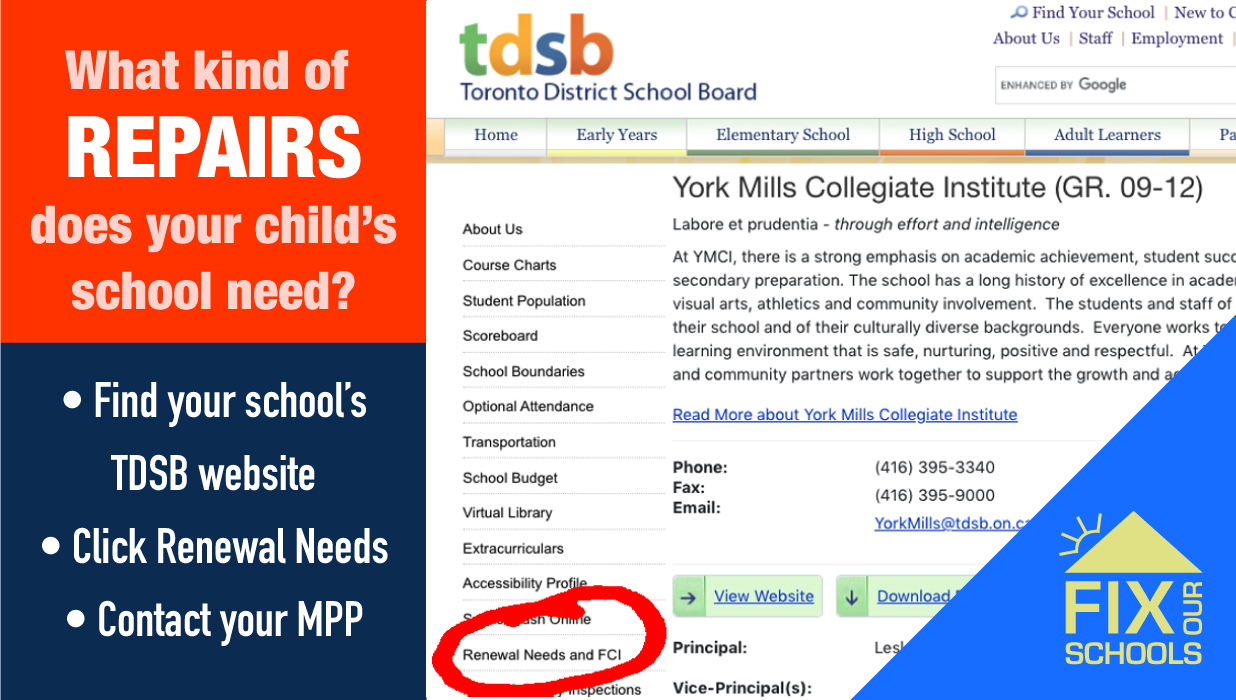
In conjunction with reviewing the detailed data on TDSB school disrepair, you may find our 2017 blog entitled, 10 Things you Need to Know About Your School’s Repair Backlog to be informative. It is an “oldie but a goodie” – and sadly, still very relevant. In addition, the TDSB media release on July 8, 2021 clearly outlined that:

  • Our provincial government is responsible for all funding for public education and schools, and that TDSB schools have been underfunded by the our provincial government for many years. Fix Our Schools believes that the TDSB is not unique in this regard, and that all school boards have been chronically and grossly underfunded by successive provincial governments.
  • The Province has allocated $275-million to the TDSB to use for school repair and renewal in the 2021-22 school year, when the TDSB repair backlog in its 588 schools is a gob-smacking $3.7-billion and estimated to continue to grow each year without more financial commitment from our provincial government.
  • Education Development Charges (EDCs) represent an opportunity for an additional $500-million in new revenue for the TDSB over the next 15 years, if the provincial government amended its regulation guiding the eligibility for and use of this money. For years, the TDSB and Fix Our Schools have been asking our provincial government to amend its outdated regulations on EDCs. To date, no changes have occurred, leaving hundreds of millions of dollars in developers’ pockets rather than invested in Ontario’s schools.

In stark contrast to the TDSB’s ongoing commitment to transparency, Fix Our Schools has been consistently disappointed with the Ford government’s lack of transparency. Since taking power in June 2018, Premier Ford’s government has consistently ignored calls to update and publicly release disrepair data for all of Ontario’s schools.  While our provincial government continues to use our tax dollars to collect school disrepair data each year, the only glimpse the public gets into this data is when a member of the opposition party asks a pointed question in a legislative committee meeting.

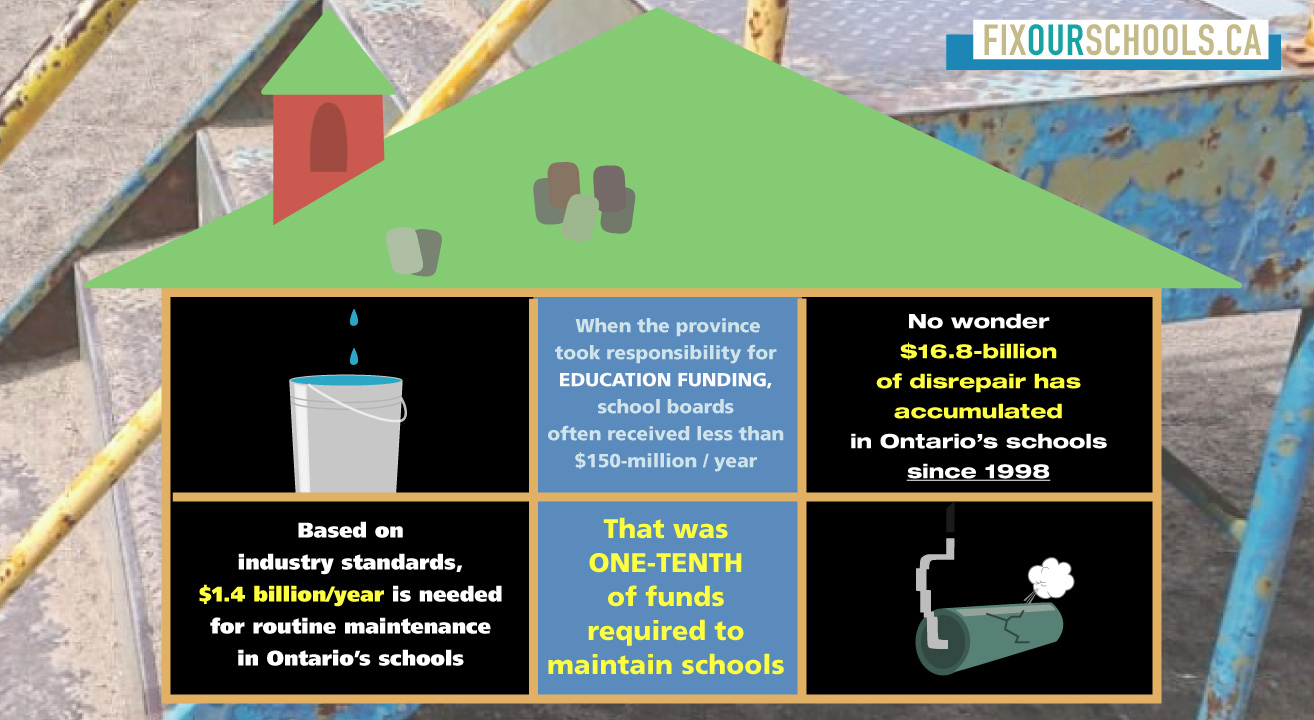
In November 2019, Education Critic Marit Stiles was able to glean from the government that the overall repair backlog in Ontario’s schools had increased to $16.3-B. As at June 9, 2021, Minister Lecce admitted that the overall repair backlog in Ontario’s schools had increased again to reach $16.8-billion. Of note is that this huge, and growing, repair backlog number does not even include assessments of portables, nor items such as indoor air quality improvements, air conditioning to address extreme temperatures, or asbestos remediation.


Fix Our Schools has consistently advocated for transparency; data and metrics to gauge outcomes; and adequate, stable funding to ensure that all Ontario’s publicly funded schools are safe, healthy, well-maintained and conducive to learning. Ontario’s children deserve nothing less. 

Premier Ford and Minister Lecce – when will you make a commitment to prioritize Ontario’s children? The clock is ticking.

Make Children a Priority Now

The Organization for Economic Co-operation and Development (OECD) recently took a deep dive into the state of school education one year into the COVID-19 pandemic. A strong, yet imperfect, relationship emerged between how countries historically value education and how frequently schools have been shut down to in-person learning during the pandemic.

Ontario has had repeated and prolonged school closures since the start of the pandemic. Students lost approximately 70 days of in-person learning in 2020, and have lost another 65 days of in-person schooling in the Greater Toronto Area in 2021. Given the OECD research, perhaps this speaks to a general lack of regard for publicly funded education and schools in this province. At Fix Our Schools, we certainly believe that Premier Ford and Minister Lecce have consistently failed to prioritize Ontario’s children, their schools and education, and their mental health. This failure may emerge as a “generational catastrophe”, according to Stefania Giannini, the top education specialist at UNESCO (United Nations Educational, Scientific and Cultural Organization).

In a CBC interview on The House, Giannini said that about 90% of the global student population has been impacted by school closures during the pandemic and that, “the UN has warned that unless education is prioritized, the world could be facing a “generational catastrophe.”  She urges governments to “think of education as a third pillar — along with health and job creation — that’s needed to end and recover from the COVID-19 crisis.”  

Closer to home, several Ontario organizations are also ringing alarm bells that publicly funded education and schools absolutely must be a priority as we transition out of the COVID-19 pandemic:

Letter to Premier Ford from the Ontario Science Table, Released on May 29, 2021

The Wilfred Laurier research briefing confirms that the following  significant harms to Ontario students have been caused by school closures. This research briefing also confirms that these harms have fallen most heavily on vulnerable populations such as students with lower socioeconomic backgrounds, racialized children and youth, newcomers, and students with disabilities:

  • Substantial deterioration of mental health status among children and youth, which will present significant long-term challenges during our recovery from the pandemic.
  • Reduction in school attendance and student achievement
  • Loss of skills development and in lifetime earnings for Ontarians
  • Reduction of social connections
  • For some Ontarians, school closures meant missing meals and other critical health services.

Beyond the findings on the impact of COVID-19 on Ontario’s students, the research paper cited above also points to the “need for an explicit education recovery strategy that is informed by data and measurement. It also highlights a significant challenge for the province: there are extensive data gaps and there has been a lack of ongoing consistent evaluation over the last year, both of which are needed for effective evaluation and recovery”.

The letter to Premier Ford from the COVID-19 Science Table also contains a look to September and beyond. The letter states that “summer will provide an ideal time to make the whole school system even safer by continuing to improve ventilation in school buildings and by vaccinating students. Moreover, Ontario should now start developing recovery plans to address the long-term mental health, health and educational problems arising from COVID-19-related school closures. This will require investments.”

OPSBA Discussion Paper, Released on May 27, 2021

The OPSBA discussion paper is designed to elicit collaborative dialogue with education partners by identifying key questions to build on current observations, identify the need for further study, and to create a frame for a new vision for school. Recognizing the COVID-19 pandemic as “one of the great social and economic disruptors of our time, with widespread impact on one of society’s most traditional institutions – school”, OPSBA’s discussion paper states, “We can’t pretend this educational roller-coaster hasn’t left many students isolated, their parents stressed and some teachers on the brink of burnout. Nor can we ignore the fact low-income and racialized families were hit hardest by both the virus and the switch to online learning. The truth is, COVID-19 reinforced inequities many students face.”

Fix Our Schools agrees wholeheartedly with OPSBA that “this is a rare once-in-a-lifetime chance to reset how Ontario provides education, a critical moment that needs everyone’s voice – students, educators, parents, trustees, everyone in our school communities.”  As Fix Our Schools previously stated, “beyond basic health and safety needs, we also need a vision of excellence for Ontario’s schools and education that is better than what was considered “normal” prior to the COVID-19 pandemic, and that this vision for excellence absolutely must be developed with input from all education stakeholders.” Given that Ford’s government was elected having a scant education policy platform, the Ford government has no mandate from the electorate to determine a vision for public education and schools without input. Ontario’s children and youth are going to need to be prioritized for many years to come.

What is Next Premier Ford and Minister Lecce?

Premier Ford and Minister Lecce: Are you willing to acknowledge that public education and schools in this province are as important as public health and job creation in order to end and recover from the COVID-19 crisis? Are you willing to prioritize and invest in public education and schools in this province? Are you willing to be transparent, and use data, standards and metrics to ensure Ontario’s students get what they deserve? So far, the answer seems to be NO.

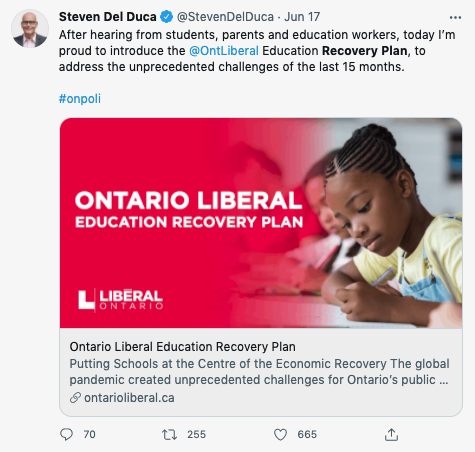
While British Columbia seems actively planning for a safe and “almost normal” back to school, Ontario’s provincial government says they will get back to us in July about what September may look like. While Doug Ford’s government continues to stall and dither on making firm investments and commitments to Ontario’s schools and education system, the Liberals announced their “Education Recovery Plan” to significantly invest in smaller class sizes, mental health, special education, learning recovery supports, safe schools and a supportive start to the school year.

The Liberals noted that every dollar invested in education returns $1.30 to our economy and that the Ontario Liberal Education Recovery Plan would pay for itself in money returned to our economy, and therefore returned to the province in increased tax revenue. Specific to school infrastructure, the Liiberals called for:

  • Cancellation of Highway 413 once and for all and a reinvestment of the $8 billion in savings into building and repairing schools, so that our children can learn in state of the art facilities measured by publicly-reported standards.
  • $525 million of provincial funding immediately (to match federal investment in urgent upgrades) to improve ventilation and filtration systems, air conditioning and window upgrades that will significantly and permanently improve air safety for COVID-19 and other illnesses.

While Fix Our Schools acknowledges that the Ontario Liberals had 15 years in power to truly fix our publicly funded schools, we appreciate the thought and specificity of their Education Recovery Plan and will be sure to hold them to account as the provincial election cycle unfolds.


Drinking Water in Schools – Another Failing Grade for Canada and Premier Ford

Before the COVID-19 pandemic took centre stage in our lives, lead in drinking water had been in the headlines. A 2019 Toronto Star article entitled, “We can do better. Province concedes it must be more transparent about lead in school water“, featured a massive investigation revealing over 2,400 schools and daycares in Ontario with exceedances of lead in drinking water over the previous two years. At that time, the provincial government had acknowledged it could “do better”.

Almost two years later, an investigative piece published on June 11, 2021 in the Toronto Star revealed that “a third of Ontario schools still have dangerous levels of lead in drinking water – two years after Province pledged to fix it.” According to this recent data, one in 10 water tests from Ontario schools and daycares showed levels of lead above Health Canada’s maximum accepted concentration of five parts per billion (ppb). Schools and daycares are not required to tell parents and students when lead exceedances are found.

Lead can have many negative impacts, including lowering IQ and triggering behavioural disorders. According to a March 2021 study published in the Annals of Epidemiology, students in Ontario schools with lead exceedances between 2008 and 2016 scored lower in reading, writing and math testing, compared with students in schools without lead exceedances.

If high lead levels are found in a school’s water supply, as per provincial guidelines, school staff must flush the pipes by opening the tap and letting cold water flow for at least five minutes, or in some instances install a filter, and in other cases decommission the tap for use. Routine flushing of pipes is the most common solution, and many experts, such as Bruce Lanphear, a leading Canadian water researcher at Simon Fraser University, view flushing as only a short-term fix that does not prioritize the health of students. Lanphear suggests that what is actually needed is to eliminate taps or fountains with lead contamination. However, removing lead pipes that wind their way through building walls and floors is expensive. Given that Ontario’s schools rely upon provincial funding for repair and renewal of schools, and given that Ontario’s schools currently have a $16.3-billion repair backlog, it is difficult to imagine school boards having the means to properly address lead in school drinking water without additional provincial support – in the form of both funding and policies.

When parents send their children to school or daycare, they presume that the drinking water available to them is safe and free from any lead. Clearly, this is still not the case – even though this issue was clearly identified back in 2019. We’d suggest the same changes we recommended years ago are urgently needed today:

The Province must institute a policy mandating all school boards to report lead exceedances to parents and students. As one school principal said in this Global News report, “a clear ministry policy would help guide schools in what they should be communicating to parents and students”. Fix Our Schools believes that transparency about the state of our children’s schools is extremely important. While certain school boards, such as the Toronto District School Board (TDSB), have committed to being transparent by routinely publishing and updating disrepair data, and by starting to publish drinking water results, this is not the norm. Therefore, we urge the provincial government to institute a clear communication policy on drinking water safety in schools and daycares to ensure full transparency. In the spirit of transparency, we’ve also been routinely calling on the provincial government to update and release its disrepair data for all of Ontario’s publicly funded schools.

The Province must provide adequate funding that is designated specifically to addressing lead in drinking water. There is currently no provincial funding provided to school boards (or municipalities) to specifically address lead in drinking water. Given that most school boards face many urgent repairs every day such as leaking roofs, unless funding is provided to address lead in drinking water, the solution in many instances where exceedances are found may just be to cap off drinking water sources and place “handwashing only” signs on sinks in classrooms. Therefore, if we want safe drinking water to be available in schools and daycares, adequate provincial funding must be provided to fix the root causes of lead in drinking water.


The Province must develop and fund a Standard of Good Repair for Ontario’s schools. There is currently no standard of good repair for Ontario’s schools that would outline the metrics that could be used to measure whether a school is, indeed, in an acceptable state for children to spend their days. While our provincial government has been diligent in collecting disrepair data in schools, this data does not reflect lead in drinking water, asbestos issues, rodents and vermin, classroom temperatures, indoor air quality, nor is disrepair tracked and reported on any portables.

While the above solutions focus on what Ontario’s provincial government must do to ensure safe drinking water in provincial schools and daycares, we must also address safe drinking water for Canada’s Indigenous Peoples, including access to safe drinking water in schools. A May 6, 2021 article in TheTyee.ca entitled, “My Community’s Boil Water Advisory Is Almost as Old as Me“, author Valerie Ooshag starts by reflecting on her remote fly-in community of Eabametoong First Nation, which has been on a boil water advisory since August 2001. Ooshag also takes a broader look to note that there were 52 long-term advisories in effect as of April 2021, impacting 33 communities. This unacceptable situation continues to exist despite a 2015 commitment by Prime Minister Trudeau to lift all boil-water advisories by 2020.

Ooshag states, “Canada is a first world country, with Indigenous populations and communities having to live under boil water advisories, with some children and youth never having had access to clean drinking water in their entire lives. In the 2015 election campaign, Prime Minister Justin Trudeau vowed to lift all boil-water advisories by 2020. It is now 2021, and yet there are still these 52 advisories affecting 33 communities that don’t have access to clean drinking water.”

Inconceivably, there is no new target date for the government to keep its six-year-old promise. We recently gave Canada and Premier Ford a failing grade and continue to do so in relation to the issue of safe drinking water for all citizens. Both Canada’s federal government and Ontario’s provincial government can and must do better on this issue.

Failing Grades for Both Canada and Premier Ford

A Failing Grade for Canada

Canada has repeatedly failed Indigenous children, their families and their communities. The discovery of 215 children buried in unmarked graves at Kamloops Residential School has highlighted that there was nothing about Canada’s Residential Schools that was safe, healthy or conducive to learning.

NOTE: Several weeks after 215 unmarked graves were found Kamloops Residential School, on June 24, 2021, the Cowessess First Nation announced a preliminary finding of 751 more unmarked graves near the former Marieval Indian Residential School in Southeast Saskatchewan. We expect additional unmarked graves will continue to be unearthed.

The Truth and Reconciliation Commission of Canada (TRC) was formed in 2007, in response to the Indian Residential Schools Settlement Agreement, the largest class-action suit in Canadian history. In June 2015, the TRC presented the executive summary of the findings contained in its multi-volume final report, including 94 “calls to action” (or recommendations) to further reconciliation between Canadians and Indigenous Peoples.

The following recommendations are specific to Education:

6. We call upon the Government of Canada to repeal Section 43 of the Criminal Code of Canada.

7. We call upon the federal government to develop with Aboriginal groups a joint strategy to eliminate educational and employment gaps between Aboriginal and non-Aboriginal Canadians.

8. We call upon the federal government to eliminate the discrepancy in federal education funding for First Nations children being educated on reserves and those First Nations children being educated off reserves.

9. We call upon the federal government to prepare and publish annual reports comparing funding for the education of First Nations children on and off reserves, as well as educational and income attainments of Aboriginal peoples in Canada compared with nonAboriginal people.

10. We call on the federal government to draft new Aboriginal education legislation with the full participation and informed consent of Aboriginal peoples. The new legislation would include a commitment to sufficient funding and would incorporate the following principles:

i. Providing sufficient funding to close identified educational achievement gaps within one generation.

ii. Improving education attainment levels and success rates.

iii. Developing culturally appropriate curricula.

iv. Protecting the right to Aboriginal languages, including the teaching of Aboriginal languages as credit courses.

v. Enabling parental and community responsibility, control, and accountability, similar to what parents enjoy in public school systems.

vi. Enabling parents to fully participate in the education of their children. vii. Respecting and honouring Treaty relationships.

11. We call upon the federal government to provide adequate funding to end the backlog of First Nations students seeking a post-secondary education.

12. We call upon the federal, provincial, territorial, and Aboriginal governments to develop culturally appropriate early childhood education programs for Aboriginal families.

So much listening, collaboration, funding, and commitment to do better is needed to address Canada’s hitherto abject failure of Indigenous children, their families and communities. 

A Failing Grade for Premier Ford and his Government 

Premier Ford and his government failed to make the public health policy decisions that could have led to better outcomes for Ontario’s students, their families, teachers, education workers and Ontario’s businesses. In Robyn Urback’s Globe and Mail opinion piece of June 3, 2021 entitled, Doug Ford’s pandemic response has been the worst of Canada’s Premiers, she states,

nowhere else in Canada have children been out of school so long, have seniors been hit with two equally devastating waves, have outdoor activities been so restricted for months, have personal service workers been forced into such prolonged shutdown and have retailers and other businesses faced such extended restrictions. And in exchange for these sacrifices, the province can boast … average case numbers, and above-average deaths.”  and also  notes, “Along with kids, Ontario’s seniors – particularly those in long-term care homes – have disproportionately borne the burden of Mr. Ford’s aimless, undisciplined approach to pandemic control.” 

Fix Our Schools’ focus continues to be on ensuring that Ontario’s schools are safe, healthy, well-maintained buildings that provide environments conducive to learning and working. Throughout the pandemic, Premier Ford has claimed that he shared this focus, and that he prioritized Ontario’s students, their schools and education, and their mental health.

However, in our opinion, Premier Ford and his government have:

and in so doing, Premier Ford and his government have ultimately failed Ontario’s students and their families and our economy.

Acknowledging this failure, we must now look forward to ensuring Ontario’s students return to school in September as safely as possible and with as much normalcy as possible, to be sure. To deliver on this goal, Premier Ford and his government must ensure standards, metrics, data and investment are in place as quickly as possible. Success also requires that Premier Ford provides leadership that allows both the education and public health sectors to maintain a steadfast focus on September.

Beyond safety and normalcy, we also need a vision of excellence for Ontario’s schools and education beyond what was considered “normal” prior to the COVID-19 pandemic. Let’s remember that pre-pandemic, $16.3-B of disrepair existed in Ontario’s schools following decades of provincial underfunding, and we had no standards in place for schools to measure whether schools and classrooms were safe, healthy, well-maintained and provided environments conducive to learning. This vision for excellence absolutely must be developed with input from all education stakeholders. Given that Ford’s government was elected having a scant education policy platform, his government has no mandate from the electorate to determine this vision on its own. Ontario’s children and youth are going to need to be prioritized for many years to come.

Citizen Advocacy Works!

A recent study found that when citizens make direct contact with their local government representative – they do influence decision-making and policy. This same study also found that sharing personal stories is a powerful way to communicate with your local government representatives. So, at a time when many people have started to disengage, feeling a lack of control and a lack of hope at times – we encourage you to dig deep and advocate on behalf of Ontario’s students.

Please email Premier Ford or call him at 416-325-1941
Please email Education Minister Lecce or call him at 416-325-2600
Please also contact your local MPP

Please share your stories with our provincial leaders. Tell them how school closures and online learning have been impacting the children in your life. As two doctors wrote, “we cannot let our children and youth become the pandemic’s collateral damage.Let’s work together to make Ontario’s children a priority now.

Will Ford Make a Decision or Simply Let the Clock Run Out?

We’ve said it before and we will say it again. Since the COVID-19 pandemic struck, Premier Ford and Minister Lecce have consistently failed to prioritize Ontario’s children, their schools and education, and their mental health. Full stop.

Last week, when Premier Ford announced metrics for a plan to re-open Ontario. One glaring omission was a re-opening plan for Ontario’s schools. A week later, there is still no plan in place, nor are there any metrics identified for when schools might safely re-open. Instead, Premier Ford has opted for a “consultative approach” to decision-making.

This change in approach was surprising from someone who, until recently, did not even take the advice of a Science Table put together specifically to provide consult on COVID decisions. It begs the question whether Premier Ford is truly concerned with making a good decision, or whether this is a technique to:

a) ensure he is not held accountable for any decision on re-opening schools?

b) run the clock so long that he avoids having to make any decision, and simply allows Ontario’s students and their families to continue to be mired in uncertainty?

And so, here we are heading into June, coming down from a third wave that, had Premier Ford adopted this more consultative approach earlier, could have been far less devastating. And so, here we are heading into June, and Ontario’s children and families continue to struggle to manage the challenges of both online learning and ongoing uncertainty. Premier Ford’s inaction and failure to prioritize Ontario’s students has been a constant during the COVID-19 pandemic.

While Fix Our Schools always endeavours to be forward-thinking and solution-oriented, this brief review of recent history in Ontario clearly shows that our provincial government has consistently opted for inaction, the wrong actions, lack of transparency, and downplaying the seriousness of COVID-19 instead of taking actions based on research, data, and the recommendations of its own Science Table and experts. Recent history also shows us that the Ford government has never truly prioritized the importance of publicly funded schools and education; and that our provincial government has never truly prioritized the health and well-being of Ontario’s students, families, teachers, and education workers.

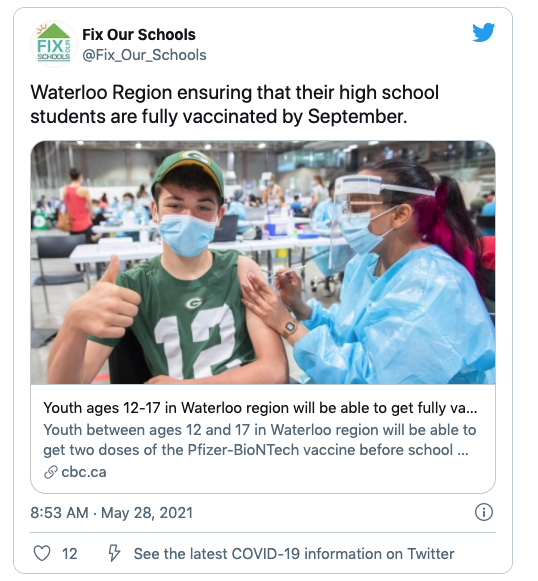
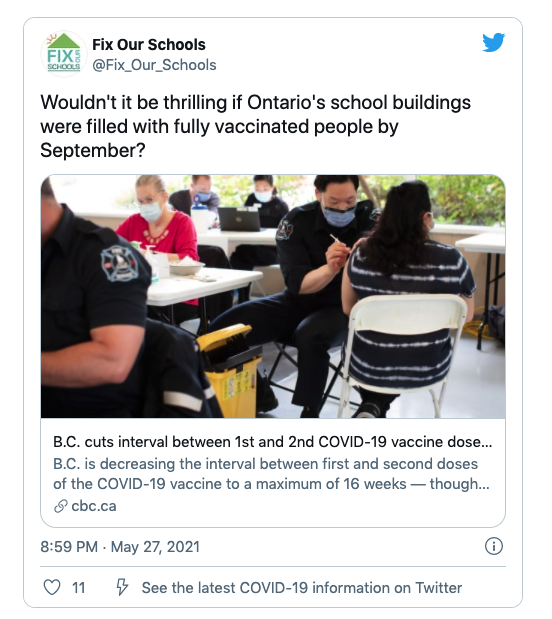
Aside from bringing clarity on metrics and a plan for the remainder of the 2020/21 school year, the Ford government must also be looking ahead to the 2021/22 school year. When Ontario’s students head back to school this coming September, wouldn’t it be thrilling if schools were filled with fully vaccinated people? Prioritizing Ontario’s students, their teachers and education workers to be fully vaccinated by August 24 (First Day of School Minus 14 days!) seems like one step towards a safe September. Already, at a local level, we are seeing certain Ontario regions move ahead with a focus on full vaccination of students.

While we’re on the topic of September, wouldn’t it be thrilling if every classroom was properly ventilated and metrics were in place for indoor air quality for our students to ensure not only their health but also an optimum learning environment? Wouldn’t it be thrilling if the Ford government actually started investing in schools to eliminate the $16.3-B disrepair that existed in these buildings even before COVID?

If the pandemic has taught us anything, it is that huge change is possible in very short-order when there is the political will for that change.

Ontario’s Children Deserve So Much Better

“Leadership is not a rank, it is a responsibility. Leadership is not about being in charge, it is about taking care of those in your charge. ”           – Simon Sinek

During the last 14 months, Premier Ford and Minister Lecce have consistently failed to take care of Ontario’s children, their schools and education, and their mental health. Full stop.

Let’s Do Our Part as Citizens to Advocate for Ontario’s Children

As Ontario’s children continue to learn online and struggle to manage the ongoing uncertainty and complexity of this pandemic, Fix Our Schools urges every parent, grandparent, aunt, uncle, teacher, education worker, and caring citizen to take a few minutes this week to advocate for our children. Please contact Premier Ford at premier@ontario.ca or 416-325-1941, and Minister Lecce at stephen.lecce.pc.ola.org or 416-325-2600, as well as your local MPP.

As a campaign that has been advocating for safe, healthy, well-maintained schools since 2014, we suspect that most of you are as disappointed as we are in our provincial’s government failure to take care of Ontario’s children, their schools and education, and their mental health. So we urge you to share your concerns, frustrations, and disappointments with our provincial leaders. Tell them how school closures and online learning are impacting the children in your life.  

When enough people take action and raise their voice collectively, positive change is possible. Solutions can be found and funding can be found when the political will exists to focus on a priority. Let’s work together to make Ontario’s children a priority now. 

As two doctors wrote in an opinion piece entitled, For the sake of the kids, don’t write off the school year just yet, “we cannot let children and youth become the pandemic’s collateral damage. School doors should be the first to open and the last to close.

A Key Part of Prioritizing Ontario’s Children is to Prioritize Schools

Fix Our Schools has advocated for seven years for safe, healthy, well-maintained schools that provide environments conducive to learning and working. Since the COVID-19 pandemic began in Spring 2020, prioritizing schools as critical infrastructure has become essential. The need for stable, adequate provincial funding to address the $16.3-billion of disrepair that existed in Ontario’s schools prior to the pandemic is evident, as is a standard of good repair for Ontario’s schools. And certainly, the need for proper ventilation in classrooms and schools to prevent COVID’s aerosol spread has received a lot of attention during the pandemic.

In a recent CBC interview, Dr. Fisman, an epidemiologist at the University of Toronto’s Dalla Lana School of Public Health and one of the co-authors of a recent Lancet paper about the airborne nature of COVID, noted that indoor spaces (where people from different households gather, like schools) “need to be well ventilated by opening the windows, cleaning the air with HEPA filters, or upgrading ventilation systems.”  In this May 10, 2021 Globe and Mail opinion piece, Dr. Fisman furthers his call to action that our primary public health policies to mitigate the spread of COVID must shift from two metres distancing and hand-washing to ventilation and high-quality masks. Fisman suggests that monitoring ventilation using portable carbon dioxide monitors is key to success, as is opening windows and improving ventilation or air filtration when ventilation systems are poor. There are many schools (and wings within Ontario schools) without any mechanical ventilation.

In a May 17, 2021 investigation piece in the Toronto Star entitled, “Blind spots raised over ventilation rules“, ventilation is cited as key: “Based on the latest scientific evidence, two metres distance with masking may not be sufficient if ventilation is poor or unknown indoors“. And, one dad in Quebec took air quality testing into his own hands and found that schools without air purifiers have three to four times more COVID-cases.

All of these findings confirm the SickKids report recommendations provided to our provincial government back in June, 2020, stating that proper ventilation was going to be a key to safe schools and classrooms amidst the COVID-pandemic. At that time, Fix Our Schools crowd-sourced ventilation issues across the province and found an alarming number of classrooms with no windows, windows that did not open, and schools with no mechanical ventilation systems. As we shared with Global TV in early September, “while the Ontario government has allocated $50 million in funding to improve HVAC systems in schools, it came only two months before classes were due to begin. It also came long after SickKids’ report cited ventilation as an important element in a safe reopening, as well as guidance from the Public Health Agency of Canada”. And as we expressed in this late August news piece,the province knew months ago that air quality issues would need to addressed, and it should have allocated the funding sooner. On the ground, principals, teachers, school boards, education workers will actually make this a safe environment, but it will be a herculean effort. It will be underfunded by the Province, and it will be a small miracle that it all comes together.”


Almost eleven months from when we first crowd-sourced data from you about ventilation in schools and nine months from the time that our provincial government announced an initial $50-M in funding for ventilation, what does ventilation look like now in your local school? We’re interested in once again crowd-sourcing real, on-the-ground information from parents, teachers, caretakers, principals, and education workers. We asked you before and we’re asking again now to please contact us today with the following:

  • name of your local school
  • any ventilation improvements that have been made (ventilation system improvement projects, introduction of air purifiers to classrooms, ensuring windows can be open)
  • any ventilation issues you may still have concerns about
  • your local MPP and/or the name of your provincial riding.

We will compile this data over the coming weeks and share our findings. Ontario’s children have been failed time and again during the COVID-pandemic. They deserve better. The way to achieve this is to create the political will within the Ford government to actually start prioritizing children, their schools and education, and their mental health.